
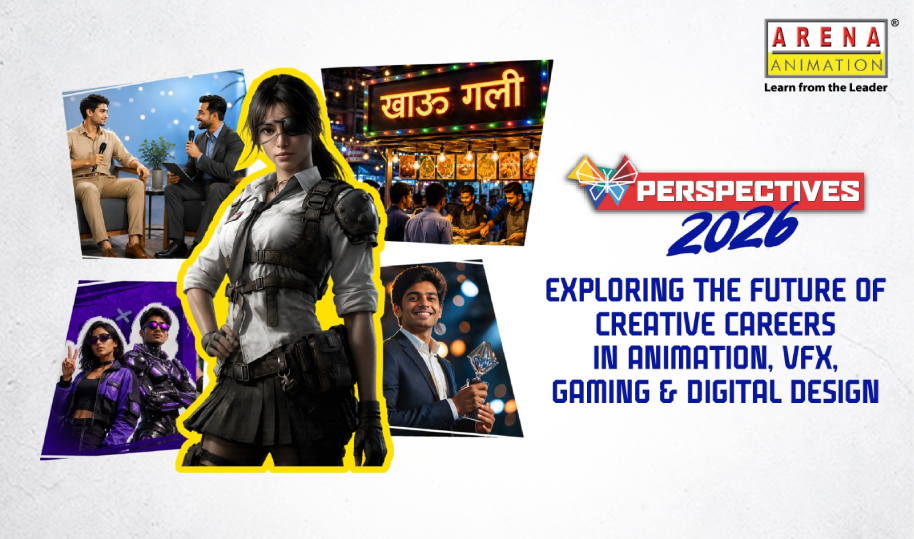
Perspectives 2026: Exploring the Future of Creative Careers in Animation, VFX, Gaming & Digital Desi...
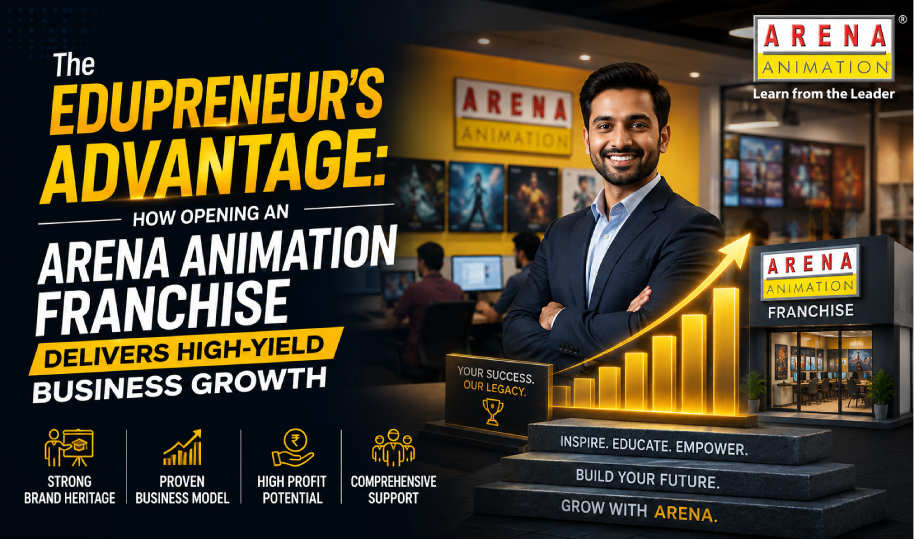
The Edupreneur’s Advantage: How Opening An Arena Animation Franchise Delivers High-Yield Business Gr...
Real-Time Worlds: How An Unreal Engine Course Unlocks Careers In Gaming, Film Sets, And Virtual Real...
Content Plus Clicks: Why Pairing Creative Visuals With A Digital Marketing Course Drives Modern Busi...
Movie Magic Decoded: Why An Animation And VFX Course Is The Ultimate Gateway To Film And OTT Studios...
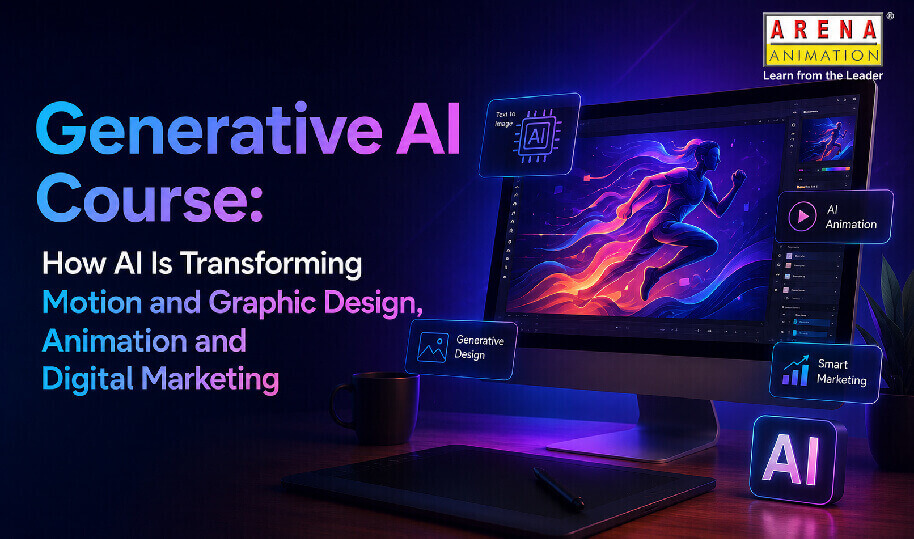
Generative AI Course: How AI Is Transforming Motion and Graphic Design, Animation and Digital Marketing
AI is changing creative industries, but it is not replacing designers, animators or marketers. It is helping professionals work faster by generating ideas, references, and content, while human creativity remains essential for strategy, storytelling, and decision making. A Generative AI course equips learners with practical AI skills, prompt engineering, ethical AI practices and real-world workflows that complement design and marketing fundamentals. As recruiters increasingly value professionals who can combine creativity with AI proficiency, learning from industry mentors and building an AI assisted portfolio can improve career opportunities in motion graphics, animation and digital marketing.
Table of Contents
- Will AI Replace Graphic Designers or Become Their Most Powerful Creative Tool?
- Will Doing a Generative AI Course Help in Your Motion and Graphic Design Career?
- Why Students in Graphic Design Animation Courses Are Learning AI
- What Will You Learn in a Modern Generative AI Course?
- How AI Is Changing Storyboarding and Character Design
- The Growing Role of AI in Digital Marketing
- What Recruiters Are Looking for Today
- Building a Portfolio in the AI Era
- Conclusion
A Generative AI course is becoming increasingly relevant across creative industries.
Open LinkedIn today and you'll find two very different conversations happening at the same time. One group believes AI will replace designers, animators, and marketers. The other is criticizing AI-generated visuals, debating whether they qualify as art and rolling their eyes at 'AI slop'.
Meanwhile, businesses are moving ahead with or without AI.
India had over 806 million internet users in 2025*, while the country's digital media industry crossed ₹1 trillion in value**. India's Generative AI market also reached approximately $1.5 billion, reflecting rapid adoption across industries***.
For creative teams, this means one thing: more content, more platforms and tighter deadlines. The challenge is no longer creating one great idea. It is adapting that idea across dozens of formats, audiences and channels.
That is why professionals across design, animation and digital marketing are increasingly investing in Generative AI skills.
Will AI Replace Graphic Designers or Become Their Most Powerful Creative Tool?
One of the most common concerns among students is whether AI will eventually replace designers.
The reality is more complicated than that.
AI can generate visuals, layouts, illustrations and campaign concepts within seconds with minimal human intervention. What it cannot reliably do is understand business objectives, brand positioning or audience psychology in the same way an experienced creative professional can. Even social media trends are difficult for AI to understand because they depend heavily on cultural and behavioral context.
Let's say you need to create a visual concept for a food delivery company planning a Diwali campaign.
AI may generate multiple festive visual concepts. But deciding:
- Which concept reflects the brand
- Which message resonates with customers
- Which creative is most likely to drive conversions
still requires human judgement and, most importantly, human ideas.
The strongest creative teams today are not choosing between AI and designers. They are combining both.
AI generates possibilities. Designers make decisions.
For creative professionals, this shift creates a clear opportunity. Learning AI is becoming less about automation and more about improving creative efficiency without sacrificing originality.
Will Doing a Generative AI Course Help in Your Motion and Graphic Design Career?
The relationship between AI and motion and graphic design is becoming increasingly practical.
Imagine an edtech company creating a promotional video for a new online course.
Before production begins, teams typically create:
- Story concepts
- Visual styles
- Character references
- Mood boards
- Marketing creatives
Traditionally, this process could take days.
Today, AI tools can help generate multiple directions within hours, allowing teams to evaluate ideas before committing significant production resources.
That does not remove the designer from the process.
Instead, it allows designers to spend less time creating time-consuming mood boards and searching for references, and more time on:
- Creative problem-solving
- Visual storytelling
- Brand consistency
- Final execution
As AI becomes part of everyday workflows, professionals who understand both design fundamentals and AI-assisted creation are becoming increasingly valuable to employers.
However, there is a catch. You need to learn Gen AI from experienced professionals. Like any tool, Gen AI comes with a learning curve and its own challenges. Watching an online tutorial can help you get started, but only a dedicated mentor can help you understand where to use AI, where to rely on human judgement, and how to avoid common pitfalls. Structured learning also helps you create content that is ethical, aligns with copyright and responsible AI practices and remains consistent with a brand's identity, tone and creative standards.
Why Students in Graphic Design Animation Courses Are Learning AI
Studios and agencies are no longer looking only for software operators. They are looking for professionals who can adapt to modern creative workflows.
Imagine two candidates applying for the same role. Both have strong portfolios. Both understand design principles. The difference is that one candidate can also use AI tools to accelerate ideation, generate references and improve production efficiency.
For many recruiters, that capability immediately adds value.
This is why students enrolled in graphic design animation courses and graphic design and animation courses are actively exploring AI alongside traditional creative training.
The goal is not to replace core design skills. The goal is to strengthen them with tools that are increasingly becoming part of professional creative environments. Learning Gen AI through real-world projects can be a game-changer for designers who want to enhance their skills and improve their efficiency without compromising creativity.
What Will You Learn in a Modern Generative AI Course?
Many people assume a Generative AI course is simply about learning prompts.
In reality, effective AI education goes much deeper.
Modern programmes typically focus on:
- Prompt engineering
- AI-assisted content creation
- Creative ideation workflows
- Visual storytelling
- Responsible AI usage
- Copyright and ethical considerations
- Integrating AI into professional creative projects
This matters because AI can generate content quickly, but speed alone does not create quality.
Without creative direction, many AI-generated outputs begin to look repetitive and generic. Today, brands that mindlessly create AI-generated graphics are often criticised for prioritising cost savings over quality. Many of these visuals appear overcrowded and struggle to capture attention. A designer who understands the limitations of AI-generated graphics uses their design knowledge to ensure visuals capture attention and do not look half-baked.
This is where structured learning becomes valuable.
For students exploring careers in design, animation and digital content creation, programmes that combine creative fundamentals with emerging technologies can provide a more industry-relevant learning experience.
With over 30 years of training experience, more than 500,000 students trained and a network of 200+ centres, Arena Animation continues to evolve its learning ecosystem to reflect changing industry demands. As AI becomes increasingly integrated into creative workflows, Arena Animation mentors help new designers understand the power and limitations of Gen AI and the best ways to use this technology to enhance their work and improve their chances of securing high-paying jobs and clients.
How AI Is Changing Storyboarding and Character Design
Storyboarding and character design have traditionally been some of the most time-intensive stages of animation production. Before a single frame is animated, artists often spend hours exploring visual directions, refining concepts and gathering references.
Today, AI is helping accelerate that process.
Artists can generate character variations, experiment with different visual styles and create mood boards much faster than before. Instead of starting with a blank canvas, creative teams can begin with multiple possibilities and refine the strongest ideas.
This is particularly valuable in animation, where production timelines are often tight and revisions are common.
However, AI does not replace artistic judgement. It can generate options, but deciding which character best fits a story or which visual direction supports a narrative still requires human creativity.
Human intervention is also essential for preserving fine details and maintaining character consistency. Lighting and scene composition still require creative judgement. Reflections, shadows and perspective correction can be assisted by AI, but understanding these principles remains critical to making the right creative decisions.
For students pursuing graphic design and animation courses, understanding how AI supports pre-production workflows is becoming an increasingly valuable skill. Do you think a one-hour tutorial is enough to replace years of practical experience, mistakes and lessons learned?
Learning from industry veterans provides insights that cannot be replicated through short online videos. Designers benefit from understanding established design principles, proven methods and emerging approaches directly from professionals who have worked on real projects.
At Arena Animation, students regularly learn through industry-veteran sessions, workshops and expert-led discussions that help them master new techniques, tools and creative workflows.
The Growing Role of AI in Digital Marketing
Instagram has become one of the largest advertising platforms for brands. Advertising has also expanded across messaging platforms, streaming services and mobile applications. As digital channels continue to grow, businesses are producing more content than ever before.
This has created increasing demand for professionals who understand both marketing strategy and AI-powered tools.
Today, AI is being used to support:
- Ad creative generation
- Content ideation
- Audience segmentation
- Campaign personalisation
- Performance testing
For marketers, the benefit is not simply faster content creation. It is the ability to test more ideas, analyze performance and optimize campaigns at scale.
This is one reason why AI in digital marketing has become an important area of focus for businesses. Professionals who can combine marketing fundamentals with AI-assisted workflows are increasingly positioned to contribute across content, performance marketing and digital campaigns.
What Recruiters Are Looking for Today
Despite growing interest in AI, recruiters are not looking for professionals who rely entirely on automation.
Instead, they are looking for candidates who can combine technical skills, creativity and adaptability. Someone who has mastered design fundamentals well enough to identify and correct errors that Gen AI may unintentionally replicate across multiple graphics.
A designer who understands AI but lacks design fundamentals is unlikely to stand out.
Increasingly, employers value professionals who can:
- Use AI tools effectively
- Think creatively
- Solve real business problems
- Adapt to new technologies
- Deliver high-quality work efficiently
As AI becomes more common across workplaces, adaptability is becoming a key hiring factor. Employers want professionals who can quickly learn new tools, integrate them into workflows and continue delivering results as technology evolves.
For students and early-career professionals, learning how to work alongside AI can become a valuable differentiator in a competitive job market.
Building a Portfolio in the AI Era
As AI-generated content becomes more common, portfolios are evolving too.
Recruiters are no longer impressed by AI-generated images alone. What they want to understand is how a candidate thinks, solves problems and develops creative ideas.
A strong portfolio today should demonstrate:
- Creative thinking
- Concept development
- Visual storytelling
- Workflow understanding
- Final execution
For example, instead of only showcasing a final character design or campaign visual, candidates can include concept explorations, AI-assisted iterations and the reasoning behind key creative decisions. This helps recruiters understand both the outcome and the process behind it.
The strongest portfolios showcase a balance between technology and human creativity. They demonstrate not only what was created but also the thinking behind it.
At Arena Animation, our faculty members help students navigate first-time portfolio creation, understand what information to include and learn how to present their work effectively during interviews. A strong portfolio can often become the difference between being noticed and being overlooked in a competitive hiring environment.
Many professionals and agency founders have strengthened their presentation skills and improved the way they showcase their work after receiving structured guidance. Understanding how to present projects in an industry-relevant manner can help creative professionals attract better opportunities, larger clients and stronger career growth.
Conclusion
AI is becoming an integral part of creative workflows across design, animation and digital marketing. The professionals who thrive will not be those who compete with AI, but those who learn how to use it effectively.
A Generative AI course can help learners understand emerging tools while continuing to build the creativity, storytelling and problem-solving skills that employers value. Through industry-focused training and practical exposure, Arena Animation helps students prepare for the future of creative careers.
References:
- DataReportal. Digital 2025: India. Published February 2025. Accessed July 21, 2026.
- EY India. India's Media & Entertainment Sector Grew 9% to INR 2.78 Trillion in 2025, Driven by Digital and Live Experiences: FICCI EY Report. Published March 24, 2026. Accessed July 21, 2026.
- IMARC Group. India Generative AI Market Size, Share, Trends and Forecast 2026 to 2034. Accessed July 21, 2026.
STUDENT ENQUIRY
Join Arena Animation and turn your creative passion into a thriving career. Your story could be the next success we celebrate.

Did you find the information you were looking for?

At Arena Animation, we craft innovative digital solutions, empowering creativity and driving growth through cutting-edge animation and design expertise.