

Perspectives 2026: Exploring the Future of Creative Careers in Animation, VFX, Gaming & Digital Desi...

The Edupreneur’s Advantage: How Opening An Arena Animation Franchise Delivers High-Yield Business Gr...
Real-Time Worlds: How An Unreal Engine Course Unlocks Careers In Gaming, Film Sets, And Virtual Real...

Content Plus Clicks: Why Pairing Creative Visuals With A Digital Marketing Course Drives Modern Busi...

Movie Magic Decoded: Why An Animation And VFX Course Is The Ultimate Gateway To Film And OTT Studios...
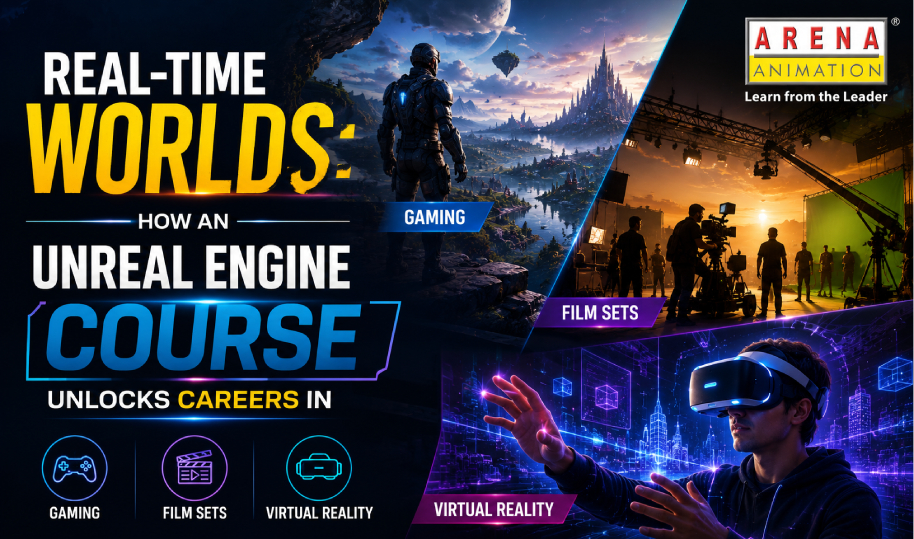
Real-Time Worlds: How An Unreal Engine Course Unlocks Careers In Gaming, Film Sets, And Virtual Reality
Ever wondered how the worlds in your favourite games and films are created? An Unreal Engine course can take your 3D skills into gaming, film and virtual production. Unreal Engine lets you build digital worlds, characters and effects in real time. If you are considering a 3D animation and VFX course, discover how learning this powerful tool can add a valuable skill to your creative toolkit.
Table Of Contents
- What Is Unreal Engine? The Game Changing Tech Behind Modern 3D Worlds
- Why Hollywood And Game Studios Are Ditching Traditional Rendering For Real Time 3D
- What You Build In An Unreal Engine Course
- High Demand Job Roles
- Why Parents Should Encourage Game Design And Real Time 3D Education
What Is Unreal Engine? The Game Changing Tech Behind Modern 3D Worlds
Unreal Engine is a real time 3D creation platform developed by Epic Games. While it is widely associated with video games, its applications now extend across film, television, virtual production, architecture, automotive design, broadcast and other visual industries.
The key difference is that you can see your 3D world come to life while you are building it. You can see this in games such as Crimson Desert, Dune: Awakening, ARC Raiders, Mafia: The Old Country and inZOI, all of which use Unreal Engine 5. Instead of making a change and waiting for a long rendering process to see the result, creators can adjust the world, lighting, characters and effects and see those changes almost instantly. This makes it easier to build detailed game worlds and understand how everything will look and work while the game is being created.
That changes the way creative teams work. Lighting, cameras, environments, characters and effects can be brought together inside an interactive digital world. Unreal Engine also supports tools such as Nanite and Lumen, helping creators work with detailed assets and dynamic lighting in real time.
For students, this means learning an engine that sits at the intersection of art, technology and storytelling. It is particularly relevant for learners pursuing animation, VFX, gaming or other forms of interactive 3D.
Why Hollywood And Game Studios Are Ditching Traditional Rendering For Real Time 3D
Real time 3D is not replacing every traditional rendering workflow. Instead, it is changing where and when rendering happens in the production pipeline.
In conventional filmmaking, creative decisions can often depend on seeing a rendered result later in the process. Virtual production changes that equation. Unreal Engine allows filmmakers to visualise environments, camera movements and scenes much earlier, while virtual production can connect digital environments with physical filmmaking in real time.
The technology is already being used in major productions. Epic Games highlights projects including Fallout, Love, Death + Robots and The Matrix Resurrections as examples of Unreal Engine being used in film and television workflows.
Gaming is another natural application. Unreal Engine provides tools for building levels, environments, gameplay systems and interactive experiences. Its Level Editor is specifically designed for constructing 3D game environments by placing and modifying objects, geometry and other elements within a world. Upcoming titles such as Gears of War: E-Day, Phantom Blade 0, Tomb Raider: Legacy of Atlantis and Alien: Isolation 2 are being developed using Unreal Engine 5, showing how the technology continues to shape the next generation of game worlds.
This convergence matters for students because the same real time 3D skill set can have applications across multiple industries rather than being restricted to one type of studio.
What You Build In An Unreal Engine Course: From Landscapes To Playable Environments
The strongest way to understand an Unreal Engine course is to look at what learners can actually create.
A student can begin with a digital environment and gradually turn it into an interactive experience. This could include creating landscapes, placing 3D assets, designing lighting, setting up cameras and developing atmospheric details that establish the mood of a scene.
As skills develop, learners can work with animation, materials, visual effects and interactive elements. Unreal Engine's tools support cinematic workflows as well as playable environments, allowing students to explore both storytelling and game development.[2]
A project based learning approach can also help students build a portfolio. Instead of simply demonstrating that they completed a module, they can showcase a finished environment, cinematic sequence, game level or real time scene.
This is particularly valuable for students combining Unreal Engine with a 3d animation and vfx course. Foundational skills in modelling, texturing, animation and VFX can be taken into a real time environment, creating a broader production skill set.
High Demand Job Roles: Environment Artist, Technical Director, And Level Designer
Learning Unreal Engine does not point towards just one job title. The platform supports several creative and technical career paths.
Environment Artist
Environment artists build the worlds in which stories and games take place. They work with landscapes, architecture, props, materials, lighting and composition to create believable digital spaces.
Level Designer
Level designers focus on how players experience a game environment. They work with spaces, layouts, gameplay elements and pacing to create levels that are functional as well as engaging. Unreal Engine's Level Editor is specifically built around the creation and modification of these environments.
Technical Artist And Technical Director
Technical artists sit between art and technology. They help solve production challenges, develop workflows and make sure creative assets work effectively within a technical pipeline. At senior levels, technical direction can involve guiding tools, pipelines and production systems.
These roles reflect the wider nature of real time 3D careers. Epic Games' own career ecosystem includes disciplines spanning art, engineering, production and design, with environment artists, character artists, level designers and technical roles represented across its teams.
The takeaway for students is simple: learning Unreal Engine is not only about learning software. It is about understanding how digital worlds are designed, built and brought to life.
Why Parents Should Encourage Learning Game Design And Careers In Gaming
For parents, game design can sometimes appear to be an extension of gaming as a hobby. The professional ecosystem is considerably broader.
Real time 3D skills are now being applied across gaming, film, television, virtual production, architecture, automotive design, fashion and broadcast. Epic Games specifically identifies these industries as areas where students can find opportunities by learning Unreal Engine.
The learning process can also develop skills beyond software proficiency. Building a digital environment requires visual thinking, problem solving, spatial understanding, attention to detail and the ability to turn an idea into a working project.
Most importantly, students can begin building a portfolio while they learn. Epic Games recommends personal projects such as a mini game, level, prototype, tool or character as useful ways for emerging talent to demonstrate their abilities.
For a student already interested in animation, gaming or visual effects, this makes real time 3D a practical addition to a broader creative education. A structured unreal engine course can provide the technical foundation while a wider 3d animation and vfx course can develop the artistic skills needed to create compelling digital worlds.
Parents do not have to choose between creativity and career readiness. The right programme can bring both together.
Conclusion
Unreal Engine is changing how digital worlds are designed, visualised and experienced across gaming, filmmaking and immersive media. For students, learning the technology can open pathways into environment art, level design, technical art, virtual production and other emerging roles. Combined with strong foundations in animation and VFX, an Unreal Engine course can turn creative interest into practical, portfolio driven skills that prepare learners for a wider real time 3D economy.
References
- Epic Games. Students And Schools: Get Ready For An Unreal Future. Read The Official Source
Epic Games. Film & Television: Unreal Engine. Read The Official Source
Epic Games. What Is Virtual Production? Read The Official Source
Epic Developer Community. Level Editor In Unreal Engine. Read The Official Documentation
Epic Games. Careers At Epic Games. Read The Official Source
Epic Games. Early Career Guide For Emerging Talent. Read The Official Source
STUDENT ENQUIRY
Join Arena Animation and turn your creative passion into a thriving career. Your story could be the next success we celebrate.

Did you find the information you were looking for?

At Arena Animation, we craft innovative digital solutions, empowering creativity and driving growth through cutting-edge animation and design expertise.