
The Rise of Short-Form Video: Skills Every Future Creator Needs...
From Prompt to Production: How AI Is Changing the Creative Workflow...
Perspectives 2026: Exploring the Future of Creative Careers in Animation, VFX, Gaming & Digital Desi...
The Edupreneur’s Advantage: How Opening An Arena Animation Franchise Delivers High-Yield Business Gr...
Real-Time Worlds: How An Unreal Engine Course Unlocks Careers In Gaming, Film Sets, And Virtual Real...
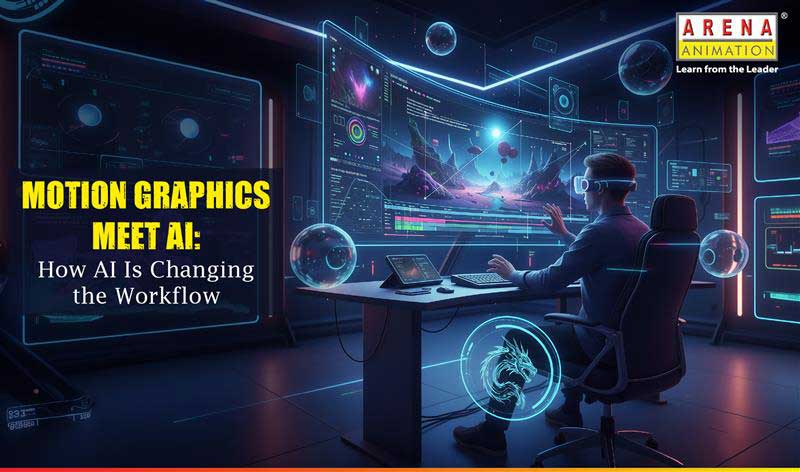
Motion Graphics Meet AI: How AI Is Changing the Workflow
There was a time when motion graphics demanded manual rendering, meticulous layering and hours of keyframing; this is now transforming. With the rise of AI in motion graphics, designers are running into a future where creativity flows faster, ideas convert into visuals in seconds and storytelling has become more dramatic, all thanks to artificial intelligence. The world of motion graphics is witnessing an evolution like never before.
Whether you are a motion designer or a content creator, understanding how AI is reshaping the craft is not an option but an essential.
Today, let’s explore how this revolution is taking place and what it means for the future of motion design.
Your new creative partner in motion design:
Artificial intelligence is not here to replace motion designers, but it is here to empower them. A better way of seeing AI is to take it as a creative partner that handles repetitive, time-consuming tasks and gives you more space to try new designs. As we see a rise in the demand for automated animation tools, we also experience smooth workflow.
AI-assisted rigging, auto-keyframing, smart interpolation, and machine-learning-based style transfers are simplifying processes that once asked for advanced technical skills. Today, designers have the freedom to focus on storytelling, visual aesthetics, and conceptual thinking, which we consider the heart of amazing motion graphics.
How AI is transforming the workflow
- Faster Ideation and Concept Development
Gone are the times when we spent hours on thinking and creating the colour combinations and look of a product. Moodboards, visual styles and concept sketches can now be generated almost instantly with the help of AI, but it still asks for human skills that bring emotions and a sense of connectivity to your designs. This is where the role of a creator becomes crucial. However, we cannot ignore the fact that AI has granted flexibility to the designers in experimenting with different looks and directions before working on a final version. - Automating Repetitive Tasks
AI design workflow enhancements have eased tasks like cloning, rotoscoping, masking and object tracking, but studios still prefer these tasks to be done manually. Though these tasks can now be automated with astonishing accuracy and let the designer focus on the creative aspects of designing, it still requires your expertise to enable a smooth workflow. - Smarter Animation
A single prompt can now generate complete motion sequences, auto-adjust easing and predict motion paths. This has helped in speeding up production and opening doors to new forms of animation that were complex and time-consuming. - Visual Consistency
Sometimes a shade darker and sometimes a shade lighter could be spotted in a video or campaign creatives. With AI this issue has now come to an end. It not only maintains a consistent look throughout a project but also analyses the styles, colours, and movement patterns. It ensures that there is a uniformity in every design and produces a highly polished result in extremely less time but with human efforts you will add extra glow to your design. - Real-Time Rendering
The biggest bottleneck in motion graphics is rendering. But when it is left up to AI, it drastically reduces render time, allows immediate previews, faster revisions and more experimentation.
A Mindset Shift
AI is not here to make designers outdated but to push them to evolve into thinkers, directors and innovators. Designers are no longer tied to technical constraints; instead, they help you bring ambitious ideas to life without compromising speed or quality.
This evolution is all across the creative industry, but it demands a shift in mindset:
- Less execution time, more time for exploration
- Less manual labour, more strategic thinking
- Less repetition, more experimentation
Result? Fast, smart and expressive motion graphics.
Final Thoughts? Let your imagination fly:
AI is here to speed up your workflow, amplify your imagination and give you space to explore. It is not a shortcut but an encouragement to give time and work on what you do best, that is, creating compelling motion stories that touch audiences’ hearts.
Whether you are starting your journey or are a seasoned designer, this is the perfect time to learn and explore AI in motion graphics with an institution that can shape your creative future.
At Arena Animation we help you to explore and create fearlessly. The next wave of motion design is here, and you can stay at the front with us.
FAQs:
- Is AI going to replace motion graphic designers?
No. AI is invented to automate tasks, not to replace human creativity, taste and storytelling; these will always require real and trained designers. - How does AI improve motion graphics production speed?
AI speeds up repetitive work like rotoscoping, asset creation, and editing, allowing the designers to focus on other aspects of designing. - What skills should motion designers develop in the age of AI?
Work on your creative thinking, storytelling and design fundamentals.
STUDENT ENQUIRY
Join Arena Animation and turn your creative passion into a thriving career. Your story could be the next success we celebrate.

Did you find the information you were looking for?

At Arena Animation, we craft innovative digital solutions, empowering creativity and driving growth through cutting-edge animation and design expertise.