
The New Creative Career: Why Designers, Animators & Editors Are Becoming Multi-Skilled Creators...
The Rise of Short-Form Video: Skills Every Future Creator Needs...
From Prompt to Production: How AI Is Changing the Creative Workflow...
Perspectives 2026: Exploring the Future of Creative Careers in Animation, VFX, Gaming & Digital Desi...
The Edupreneur’s Advantage: How Opening An Arena Animation Franchise Delivers High-Yield Business Gr...
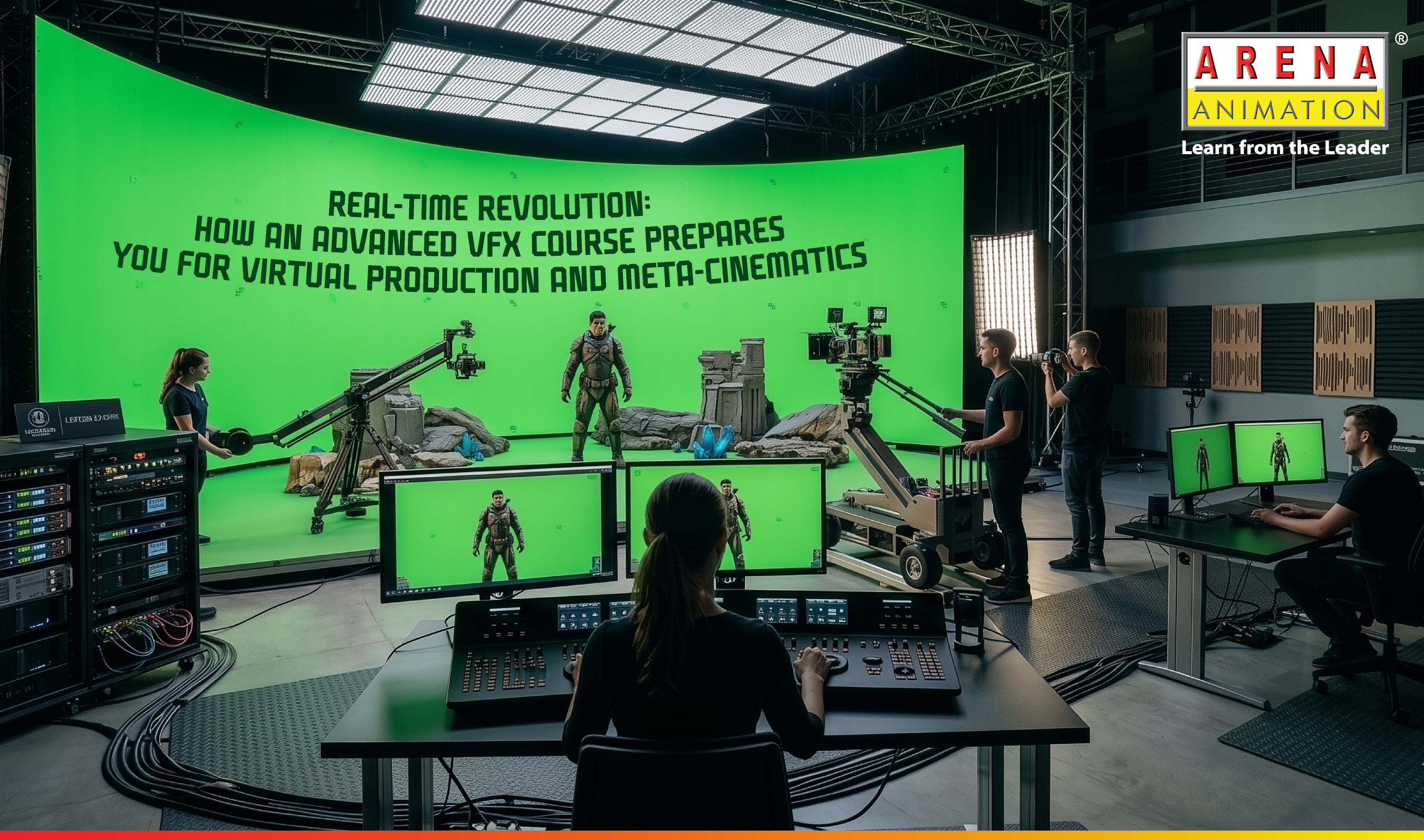
Real-Time Revolution: How an Advanced VFX Course Prepares You for Virtual Production and Meta-Cinematics
If you have ever watched a film scene and genuinely could not tell where the real set ended and the digital world began, you have already seen what the VFX industry has been quietly building toward. That seamless blend of physical and virtual is no longer exclusive to the biggest Hollywood productions. It is becoming the standard across film, streaming, advertising and immersive media. And for anyone seriously considering an advanced vfx course right now, understanding what is driving that shift is the most important context you can have before you begin.
Virtual production, real-time environments and meta-cinematics describe a genuine transformation in how visual stories are built and professionals who understand this shift are exactly who studios are looking to hire.
What Has Actually Changed on Set
For a long time the standard workflow was: shoot against a green screen, send the footage to post-production, wait weeks or months for the effects to be added later. That workflow still exists but it is no longer the dominant approach at the cutting edge.
What has replaced it is virtual production. Massive curved LED volumes now display photoreal digital environments in real time while filming happens. Actors perform in front of them, directors see the final image through the lens as they shoot and VFX artists adjust lighting and environments on the spot rather than months later. Real-time rendering engines like Unreal have redefined how directors, cinematographers and VFX artists work together on a single production.
This changes what a VFX artist actually does, therefore, changing what training needs to cover.
Meta-Cinematics and Why It Matters for Your Career
Meta-cinematics describes cinematic content that exists across multiple planes, film, game engines and interactive environments, all sharing the same visual assets. Think about how the line between a film universe and an interactive world is dissolving. Streaming platforms and studios are investing in content that works across both simultaneously.
For a student entering the field today this matters because the skills required to work in this space go beyond traditional post-production. They involve real-time tools, game engine familiarity and an understanding of how visual storytelling works when audiences can move through it rather than simply watch it. A strong vfx design course built for this era needs to address all of those layers and not just the fundamentals that defined the field a decade ago.
The Tools You Actually Need to Know
A few names keep appearing when you read about how major productions are being made right now. Unreal Engine appears frequently because it has become the backbone of many real-time virtual production pipelines, far beyond the gaming industry. Nuke remains the industry standard for compositing. DaVinci Resolve has expanded into a full post-production environment that major productions now rely on end to end. After Effects is still widely used across advertising and content creation.
A student finishing a vfx editing course today should be coming out with hands-on experience across several of these tools, not just a theoretical introduction to what they are. The industry expects artists to be able to open the software and work on day one.
What Virtual Production Actually Demands From You
There is something worth understanding about virtual production in vfx as a career direction. It requires a different way of thinking about the entire production process and not just a different set of software skills.
In a conventional workflow a VFX artist often works in post, receiving footage and building effects around it after the shoot. In a virtual production environment you are part of the shoot itself. Decisions happen faster, adjustments are made in real time and your understanding of how physical and digital elements interact has to be immediate.
Communication, problem-solving under pressure and a broad understanding of the production pipeline become just as important as technical proficiency. Students who train in environments that simulate this kind of real-time decision making are significantly better prepared than those who only learn the tools in a controlled setting.
What a Good Advanced VFX Course Actually Covers
An advanced VFX course designed for where the industry is today will go well beyond the basics. Compositing that goes into multi-layer environment integration, real-time rendering principles, colour grading for both traditional and virtual production outputs, motion graphics and an understanding of how VFX assets are built for reuse across platforms.
Arena Animation's Advanced Program in VFX Compositing and Editing is structured around exactly this. The program covers compositing on professional tools, colour correction, rotoscoping, motion graphics, sound design and editing for vfx film making contexts. Students build a demo reel throughout the program, which in this industry is the most important thing you can carry into any job conversation. A certificate tells someone you completed a course. A reel tells them what you can actually do.
Where This Can Take You
VFX compositors work across film, television and streaming. Motion graphics artists are needed in advertising, broadcast and digital content. Real-time VFX artists working within game engine pipelines are one of the fastest growing specialisations right now. Colour grading specialists are needed on virtually every professional production.
Across all of these paths the demo reel is the entry point which is exactly why what you build during your training matters as much as the curriculum itself.
Final Thoughts
The tools are evolving quickly and virtual production is no longer a niche technique used by only a handful of studios.
Students who start building these skills today are stepping into an industry that is actively changing. The professionals who will shape how cinematic stories get told over the next decade are being trained right now.
STUDENT ENQUIRY
Join Arena Animation and turn your creative passion into a thriving career. Your story could be the next success we celebrate.

Did you find the information you were looking for?

At Arena Animation, we craft innovative digital solutions, empowering creativity and driving growth through cutting-edge animation and design expertise.