
The New Creative Career: Why Designers, Animators & Editors Are Becoming Multi-Skilled Creators...
The Rise of Short-Form Video: Skills Every Future Creator Needs...
From Prompt to Production: How AI Is Changing the Creative Workflow...
Perspectives 2026: Exploring the Future of Creative Careers in Animation, VFX, Gaming & Digital Desi...
The Edupreneur’s Advantage: How Opening An Arena Animation Franchise Delivers High-Yield Business Gr...
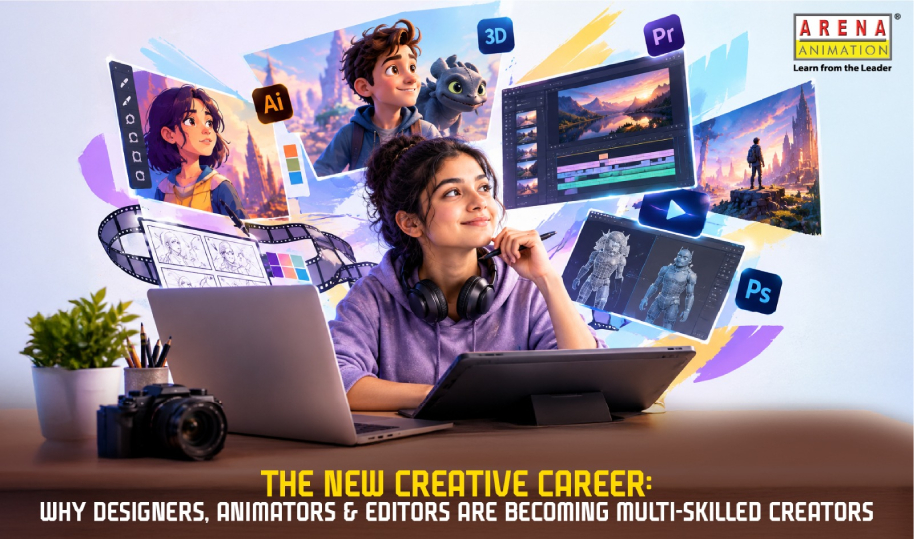
The New Creative Career: Why Designers, Animators & Editors Are Becoming Multi-Skilled Creators
The idea of choosing one creative skill and building an entire career around it is becoming less practical in a rapidly changing digital industry. Designers are increasingly working with motion, video and AI tools while animators are interacting with editing, VFX and digital design workflows. Similarly, editors may need to understand graphics, sound and visual effects to create content that works across modern platforms.
This does not mean every creative professional needs to master every discipline. It means that having an understanding of related skills can make it easier to collaborate, adapt and take on a wider range of projects.
The rise of the multi-skilled creator is therefore changing how students should approach creative education. Aspiring professionals can now benefit from considering how different capabilities fit together.
TL;DR
Creative careers are becoming more interconnected, with designers, animators and editors increasingly working across related disciplines. Building depth in one core skill while developing supporting skills in motion, editing, VFX and AI can help aspiring creators adapt to broader creative workflows and build more versatile portfolios.
Table of Contents
- Why creative roles are becoming broader
- The designer who understands motion
- The animator who understands design and editing
- The editor who understands visual effects
- How AI is changing the hybrid creator
- Building a cross-disciplinary portfolio
- Choosing the right learning pathway
- Conclusion
- FAQs
Why Creative Roles Are Becoming Broader
Digital content is now produced for many different formats. A single campaign may involve static graphics, animated posts, short videos, websites and interactive content. This means creative teams often need professionals who can understand how different forms of content connect.
- From Specialist to Hybrid Creator
Specialisation still matters. A skilled animator brings knowledge that a generalist may not have. However, understanding adjacent disciplines can make that specialist more effective.
An animator who understands editing can think about how individual shots will work within the final sequence. A designer who understands motion can create graphics that transition naturally into video. An editor who understands VFX can plan shots more effectively before post-production begins. This combination is becoming increasingly valuable in modern creative workflows.
The Designer Who Understands Motion
Graphic design is no longer limited to static layouts. Brands communicate through social media, digital advertising, websites and video platforms where visual elements frequently move.
A designer who understands motion can create typography, logos and graphic elements that work across both static and animated formats.
- The Growth of Next-Gen Graphic Design
Arena Animation's current Digital Design portfolio includes Next-Gen Graphic and Visual Design, Advanced Program in Motion Graphics and Design and Digital Content Creation. Its Next-Gen Graphic and Visual Design program covers areas including typography, vector illustration, digital advertising, Gen AI-powered social media content creation, product visualisation and branding.
This reflects the broader direction of next-gen graphic design. The designer increasingly needs to think about how a visual identity behaves across multiple platforms rather than how it appears in a single layout.
The Animator Who Understands Design and Editing
Animation is not only about movements but also about composition, colour, lighting, sound and editing. All these influence how an animation is experienced.
A student pursuing 2D and 3D animation courses can therefore benefit from learning related visual communication skills.
- Understanding the Complete Sequence
Consider a short animated advertisement. The animator may create the movement but the final result also depends on how scenes are framed, when cuts occur, how text appears and how sound supports the action.
Arena's Advanced Program in Animation and VFX includes areas such as cinematography, colour and lighting, character design, cinematic editing, digital sound craft, motion graphics and AI-based creative work alongside animation and VFX. This broader exposure helps students understand that animation is part of a larger production process.
The Editor Who Understands Visual Effects
Video editors are also becoming more involved in visual storytelling. Modern digital content frequently combines live footage with motion graphics, effects, text and generated elements.
An editor who understands the basics of VFX can communicate more effectively with compositors and other specialists. They can also make better decisions about shot selection and sequencing.
- Editing as a Creative Discipline
Editing is not simply arranging clips in chronological order. It involves controlling pace, emotion, information and attention.
A creator working on a short video may need to decide where a graphic appears, when music changes, how quickly a sequence develops and where a visual effect should be introduced. Understanding related disciplines gives editors more creative control over these decisions.
How AI Is Changing the Hybrid Creator
Artificial intelligence is accelerating the movement towards broader creative workflows. Creators can now use AI for ideation, visual exploration, content generation and other stages of production.
Arena's Master in Gen AI includes prompt engineering, creative writing, visual storytelling, video content creation, audio innovation and 3D model creation.
- AI Adds Another Layer of Creative Literacy
The important skill is not simply knowing which AI tool to open. Creators need to understand what the tool is suitable for and how its output fits into a larger production process.
A designer may use AI to explore concepts before refining the selected direction manually. An animator may use generated references during early development. An editor may use AI-assisted features to speed up certain tasks while retaining control over the final sequence.
This makes AI literacy part of the wider skill set rather than a replacement for creative fundamentals.
Building a Cross-Disciplinary Portfolio
A multi-skilled creator needs evidence that those skills can work together. This is where portfolio development becomes important.
Instead of presenting unrelated exercises, students can create projects that demonstrate connected abilities.
- Showing Complete Projects
A student could create a fictional brand and develop its identity, social media graphics, animated logo and short promotional video. An aspiring animator could create a character, storyboard a short sequence, animate it and edit the final piece with sound. Such projects show employers that the student understands how different skills contribute to a finished outcome.
Arena's programmes place emphasis on practical projects and portfolio creation, while its Digital Content Creation programme describes its learning outcome as developing versatile digital creators capable of working across visual communication, motion graphics and AI-driven design.
Choosing the Right Learning Pathway
Students do not need to learn everything at once. A better approach is to begin with a primary discipline and then develop supporting skills around it.
Someone interested in visual storytelling could begin with animation and gradually add editing and motion graphics. A student interested in branding could start with graphic design and explore motion and digital content creation.
- Building Depth Alongside Breadth
Breadth becomes useful when it is supported by depth. Learning five disciplines superficially may not be as valuable as becoming strong in one area while understanding several connected ones.
Arena offers different pathways across animation, VFX, gaming, digital design, UI/UX, digital content creation and short term programmes. Its current course portfolio also includes specialised programmes in areas such as Unreal Engine, Blender, Maya, motion graphics and Gen AI. This allows learners to build their education around their interests while gradually expanding their creative toolkit.
Conclusion
The modern creative career is becoming more interconnected. Designers are exploring motion, animators are working across editing and VFX and editors are increasingly expected to understand graphics, sound and effects.
For students, this does not mean abandoning specialisation. It means building a strong primary skill and developing enough knowledge of related disciplines to work confidently across a modern production workflow.
Animation and design courses, graphic design and animation courses and specialised pathways in motion graphics, VFX and digital content creation can provide different starting points. The strongest career strategy is to combine depth with adaptability.
The next generation of creative professionals will not only be defined by the number of tools they know but also by how effectively they can connect ideas, skills and technologies to create work that has a clear purpose.
FAQs
- Does learning multiple skills reduce specialisation?
Ans - No. A strong primary skill can remain the foundation while supporting skills make a professional more adaptable and effective.
- What is next-gen graphic design?
Ans - Next-gen graphic design combines traditional design principles with digital workflows, motion, AI assisted creation, branding and other emerging forms of visual communication.
- Are 2D and 3D animation courses still relevant?
Ans - Yes. Both remain important creative disciplines while additional skills in editing, design, VFX and emerging technologies can broaden their professional applications.
- Can students learn multiple creative skills through one Arena Animation program?
Ans - Yes. Several Arena Animation programs combine related creative disciplines. For example, the Digital Content Creation program covers visual design, motion graphics, UI/UX and storytelling, along with AI-powered workflows.
- Which Arena Animation course combines animation, VFX and related creative skills?
Ans - The Advanced Program in Animation and VFX covers animation, 3D design and VFX along with cinematography, colour and lighting, cinematic editing, digital sound craft and motion graphics. It also includes AI Art Innovator and Gen AI tools.
- Does Arena Animation offer a program for combining graphic design with motion and AI?
Ans - Yes. Next-Gen Graphic & Visual Design combines graphic and visual design with motion graphics, Gen AI-powered social media content creation, product visualisation and branding. The program also includes Gen AI tools as part of its learning.
STUDENT ENQUIRY
Join Arena Animation and turn your creative passion into a thriving career. Your story could be the next success we celebrate.

Did you find the information you were looking for?

At Arena Animation, we craft innovative digital solutions, empowering creativity and driving growth through cutting-edge animation and design expertise.