
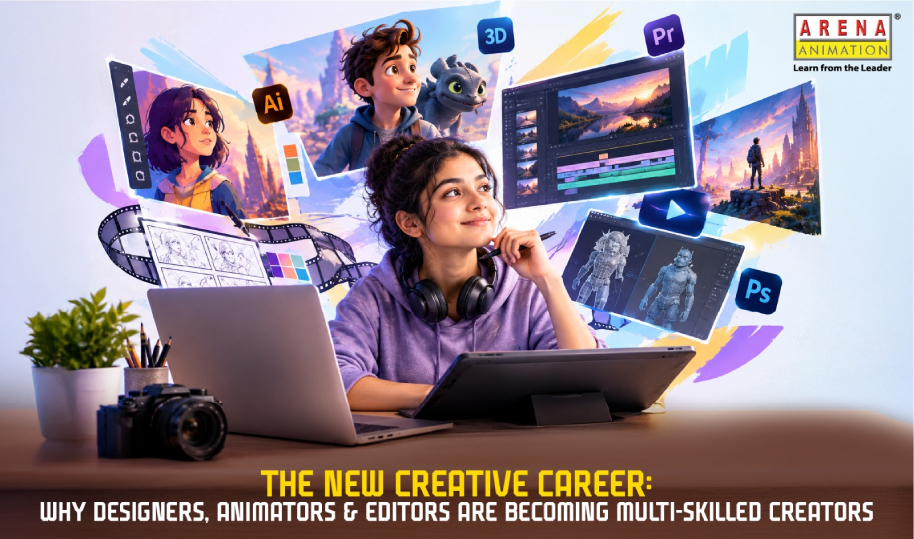
The New Creative Career: Why Designers, Animators & Editors Are Becoming Multi-Skilled Creators...
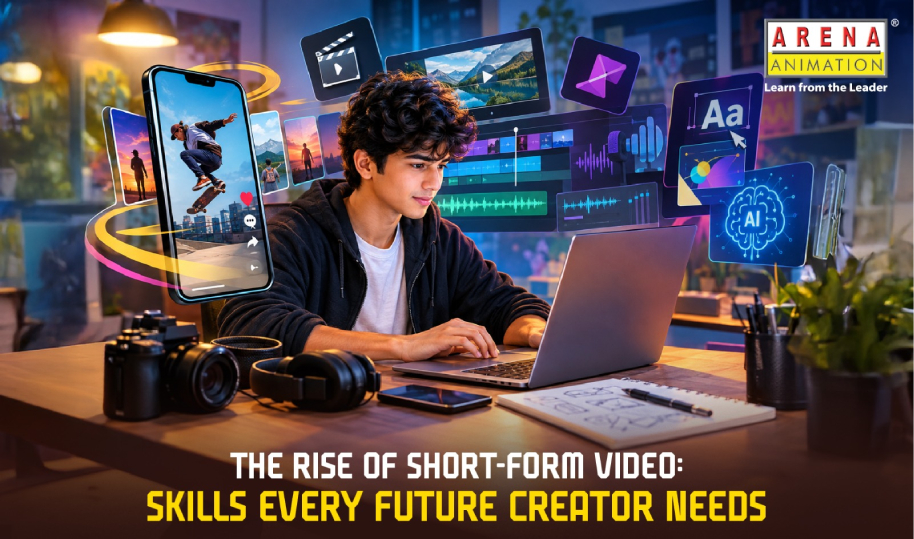
The Rise of Short-Form Video: Skills Every Future Creator Needs...
From Prompt to Production: How AI Is Changing the Creative Workflow...
Perspectives 2026: Exploring the Future of Creative Careers in Animation, VFX, Gaming & Digital Desi...
The Edupreneur’s Advantage: How Opening An Arena Animation Franchise Delivers High-Yield Business Gr...
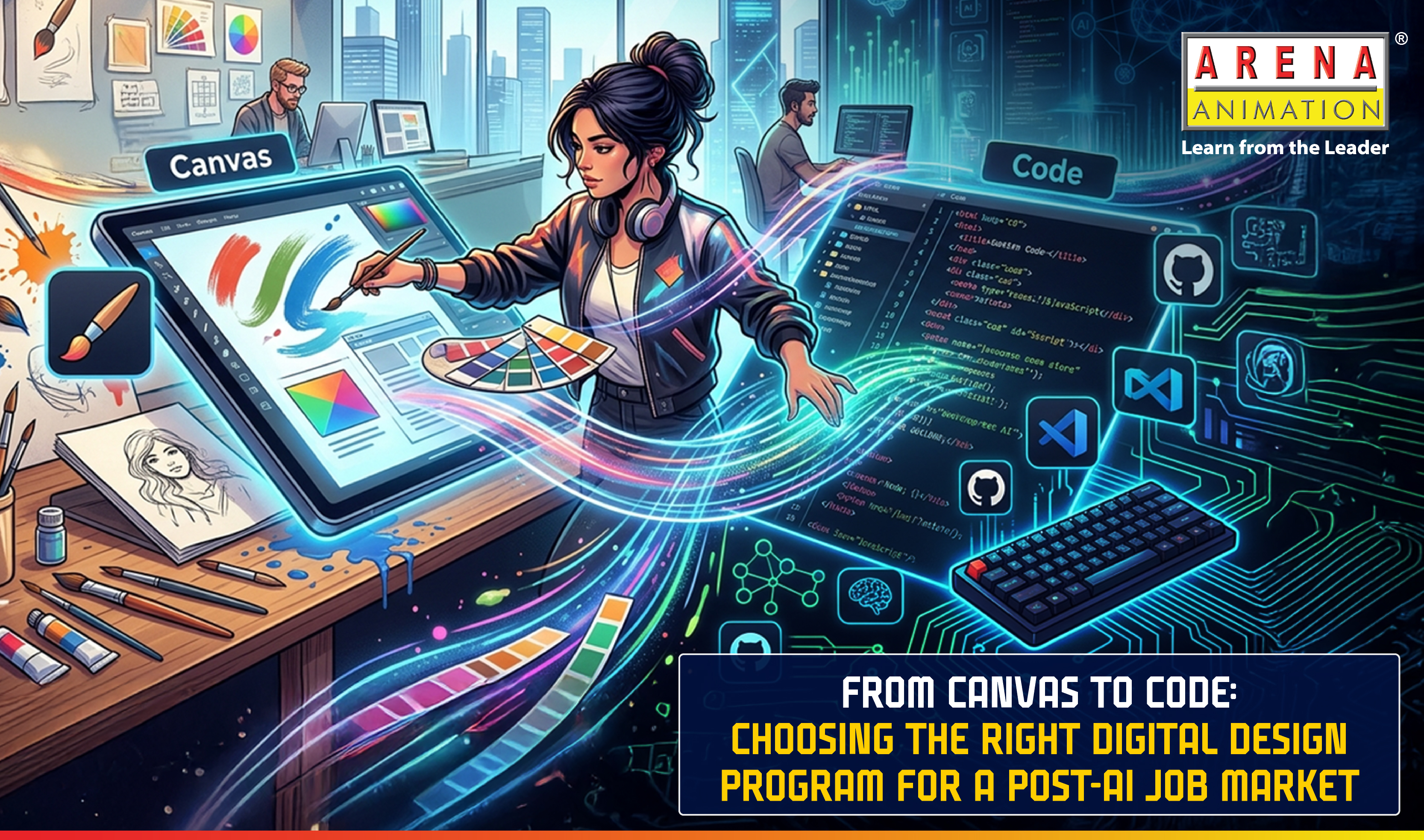
From Canvas to Code: Choosing the Right Digital Design Program for a Post-AI Job Market
Most people who end up in design will tell you it started small. A font that caught their eye, a logo they could not stop staring at, or an app that just felt satisfying to use. If any of that sounds familiar, you have probably already searched for a digital design course at least once. And if you are a student trying to figure out what comes next, or someone who has been working in a different field and wants to move into something creative, the timing actually could not be better.
There is one question though that almost every aspiring designer is sitting with right now. With AI generating visuals in seconds, is there still a future in this?
There absolutely is. But it looks a little different from what people expect.
Design Was Never Really About Looks
Ask a designer what they actually do all day and you will get an answer that surprises most people. Yes, there is visual work involved. But a lot of what goes into design is thinking, not drawing.
Why is that button placed there and not somewhere else? Why does that particular shade of blue make a banking app feel trustworthy? Why does one layout make you read all the way to the bottom while another sends you clicking away in ten seconds? These are not accidents. These are the result of deliberate decisions made by skilled designers who understand how people think and behave.
That is the part of design that most people do not see. It is also the part that takes time to learn properly, which is why students who start out self-teaching often hit a point where proper digital design training starts to feel necessary. There is genuine knowledge behind visual communication, and once you get a handle on it, your work changes in ways that are hard to describe but very easy to see.
The Honest Truth About AI and Your Career
Nobody is going to pretend that AI has not changed things. It has. Tools that used to require hours of manual work now take minutes. Generating a starting concept, testing colour combinations, resizing assets across formats, all of that has become faster. If you are a designer who knows how to use these tools, you are honestly more productive than someone who refuses to touch them.
But here is the part that gets left out of most of these conversations. AI does not know your client. It does not understand the difference between what a brand says it is and what it actually needs to communicate. It cannot read a brief, pick up on a subtle tone and make a judgment call about whether something is right or wrong for a specific audience. You can.
That gap is where design as a profession actually lives. And it is why the best digital design courses today are not ignoring AI, they are teaching students how to bring it into their workflow without losing the judgment and intention that makes design worth anything in the first place. Instead, they focus on helping you use these tools to explore more ideas, work more efficiently and deliver stronger outcomes, all while building on that core sense of judgment
What Changes When You Move From Traditional Art to Digital Work
Coming into design from a background in drawing, painting or even just a habit of noticing visual things is not a disadvantage at all. That eye for detail, that instinct for what looks right, it carries over completely.
What digital work asks of you on top of that is a different kind of awareness.
A graphic on social media has maybe three seconds before someone keeps scrolling. A website layout needs to guide a visitor from arriving to taking action, without them ever feeling pushed or confused. A mobile interface has to work perfectly on a screen the size of your hand and still make sense when it scales up to a desktop. None of this happens by accident and none of it is purely aesthetic.
A solid digital design program builds these instincts deliberately. You learn typography not just as a style choice but as a tool for guiding attention. You learn colour not just because it looks good but because it creates feeling. Layout, spacing, visual hierarchy, these things shape how an audience experiences content, often without them realising it at all.
Why Your Portfolio Matters More Than Your Certificate
Design is one of the few fields where what you have made carries more weight than where you studied. When a studio is hiring or a client is looking for someone to trust with a project, the first thing they ask for is work. Not grades, not a transcript but work.
This is why digital design training that is built around real projects tends to serve students so much better than courses that lean heavily on theory. When every assignment feels like a real brief, you finish it with something you can actually show people. Over time, piece by piece, you build a portfolio. And in this industry that portfolio is genuinely your most valuable professional asset.
Arena Animation builds its programs with this outcome in mind. The Digital Design program covers tracks like Graphic and Web Design, UI/UX, Content Creation and Motion Graphics, so students are working on the kind of projects that reflect what the industry actually looks like. Specialised pathways like Digital Communication Design and Graphics, Web Design and Development, give students the chance to go deeper in the direction that genuinely interests them. By the end of the program you are not just walking away with a certificate. You also gain practical experience and skills that actually matter in real-world roles, along with a solid body of work to show for it.
Where This Can Actually Take You
Part of what draws students toward digital design is realising how many different careers sit inside it. Branding and visual identity work. UI and UX design for products and platforms. Motion graphics for video content. Digital illustration. Web design. Content design for campaigns and social media. These are all distinct paths, each with their own community of professionals and their own kind of work.
The good news is that you do not have to decide everything upfront. A lot of students discover where they want to go by trying things, finishing projects and noticing what they enjoyed most. The variety built into a well-structured program gives you that room to explore.
Freelancing is also worth mentioning because it is a more realistic option than many students assume. Small businesses, content creators and startups all need design work on a regular basis and a huge portion of that work gets done by independent designers, not in-house teams. Your skills can take you to a full time role, an agency, or your own client list. Often all three at different points in your career.
Finding the Right Place to Learn
The syllabus matters but so does the environment around it.
Arena Animation is built for students and people entering the creative industry, not as an afterthought but as the actual point of the programs. If you are coming in with no professional design experience, the structure is designed to take you from foundational thinking to real project work in a way that builds confidence alongside skill. You are not just watching and absorbing. You are doing, which is the only way design knowledge actually sticks.
What also sets it apart for serious learners is the emphasis on professional habits alongside technical ones. How to approach a brief. How to develop a design concept from scratch rather than copying a trend. How to present your work and talk about the decisions behind it. These are the things that separate someone who knows design tools from someone who thinks and works like a designer.
Being around other students who care about the same things adds something too that is genuinely hard to replicate on your own. Creative environments push you in ways that solo learning simply does not.
Final Thoughts
Every generation of designers has had to adapt to new tools. Print gave way to digital. Static gave way to motion. The designers who built on a real understanding of communication and visual thinking adapted every single time, because the tools changed but the need for good judgment never did.
That is still true. Businesses still need visuals that communicate clearly in crowded spaces. Audiences still need interfaces that feel intuitive. Brands still need identities that mean something. None of that is going away.
Creators who take their digital design training seriously, build genuine portfolios and keep their curiosity about the field alive will find that the market still has plenty of room for them. It probably always will.
The shift from canvas to code is just the current chapter. And if you are reading this, you are already thinking about where you fit in it.
STUDENT ENQUIRY
Join Arena Animation and turn your creative passion into a thriving career. Your story could be the next success we celebrate.

Did you find the information you were looking for?

At Arena Animation, we craft innovative digital solutions, empowering creativity and driving growth through cutting-edge animation and design expertise.