
The New Creative Career: Why Designers, Animators & Editors Are Becoming Multi-Skilled Creators...
The Rise of Short-Form Video: Skills Every Future Creator Needs...
From Prompt to Production: How AI Is Changing the Creative Workflow...
Perspectives 2026: Exploring the Future of Creative Careers in Animation, VFX, Gaming & Digital Desi...
The Edupreneur’s Advantage: How Opening An Arena Animation Franchise Delivers High-Yield Business Gr...
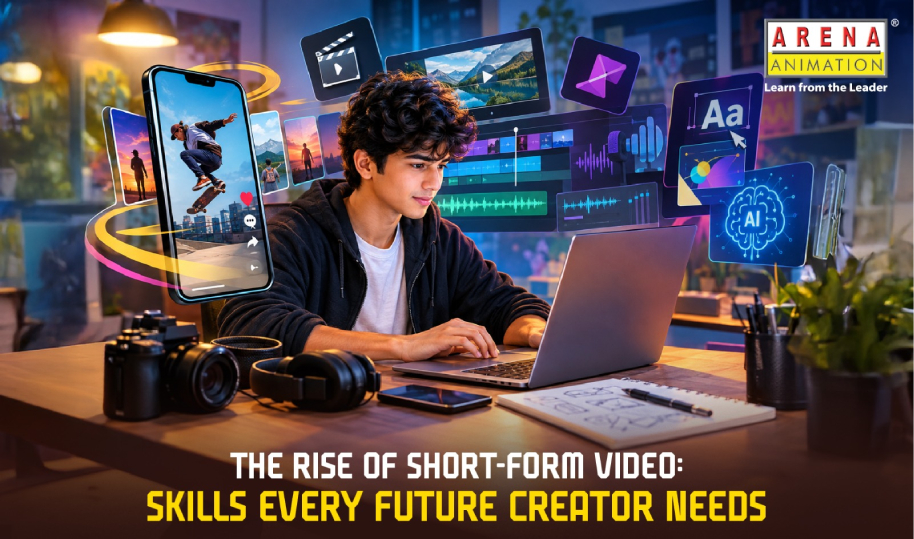
The Rise of Short-Form Video: Skills Every Future Creator Needs
Most people scroll past a video before it even finishes loading properly. A reel or a short gets roughly two seconds to prove itself and if nothing grabs attention in that window, the thumb keeps scrolling. This pressure has built an entire craft around it over the past few years, one built on editing rhythm, tight pacing and storytelling squeezed into a format with almost no room for a slow start. A motion graphics course or an audio video editing course can teach the tools but the actual skill sits in judgement, knowing when a cut should land, when a sound should hit and when a video has already made its point. That judgement is the real core of digital content creation, not the software running behind it.
TL;DR
Short-form video demands strong skills in editing rhythm, sound design, motion graphics and visual storytelling. AI can streamline repetitive editing tasks but creative judgement remains essential. Learning how to combine these skills through digital content creation and specialised training can help aspiring creators produce engaging videos built for fast-moving platforms.
Table of Contents
- Why Short-Form Video Demands a Different Skill Set
- Editing Rhythm, Transitions and Sound Design
- Motion Graphics and Visual Storytelling
- How AI-Assisted Editing Fits Into the Workflow
- Building These Skills with the Right Training
- Conclusion
- FAQs
Why Short-Form Video Demands a Different Skill Set
A film editor cuts between scenes. A short-form editor cuts between beats, and treating those as the same skill is where a lot of beginners go wrong. Every second in a fifteen-second video has to justify itself, since there is no runway for a slow build the way a five-minute video does.
Vertical scrolling trained an entire audience to expect pacing that older forms of editing were never built for. This is part of why a vfx editing course matters here too, since a lot of the visual shorthand used in short-form work was borrowed from bigger productions and scaled down to fit a smaller screen.
Editing Rhythm, Transitions and Sound Design
Rhythm is the hardest thing to teach in editing as it does not come from a rulebook. It comes from noticing how a cut lands against a beat of music or how holding a shot half a second longer can change the entire feel of a scene.
- Sound Design as a Storytelling Tool
Sound gets ignored constantly in short-form work but it usually does more of the heavy lifting than the picture does. A single sound effect placed at exactly the right frame can turn a plain, forgettable clip into something someone watches twice.
A good transition supports the story instead of showing off, something that most audio video editing course programs spend real class time teaching. Layering sound design with music and dialogue is harder than it looks.
Motion Graphics and Visual Storytelling
Motion graphics have quietly become the glue holding short-form content together. A title card, a kinetic text overlay, a quick graphic dropped mid clip to explain something fast, these small pieces decide whether a video looks put together or thrown together, and a motion graphic design program teaches students to build them quickly.
How AI-Assisted Editing Fits Into the Workflow
AI now handles a fair share of the repetitive parts of short-form editing. Auto captioning, rough cut assembly and basic sound cleanup do not require much creative judgement, and none of it takes the editor out of the process either.
Captions can be generated in several styles almost instantly, and a horizontal clip can be reframed for vertical platforms far faster than manual work used to allow. Students coming through a solid digital content creation program treat AI output as a rough draft rather than a finished one.
Building These Skills with the Right Training
Understanding short-form video takes more than experimenting with editing apps on your own. Creators need to develop an eye for pacing, storytelling, sound and visual design while learning how different tools fit into a professional workflow.
At Arena Animation, students can build skills relevant to short-form content creation, including video editing, motion graphics, sound, visual storytelling and digital content creation through industry-focused training. The focus is not simply on learning software, but on understanding how these creative elements work together to create engaging content for fast-moving digital platforms.
Conclusion
Short-form video is not a lesser version of longer content, it is its own craft with its own rules, built on editing rhythm, sound design, motion graphics and AI-assisted tools working together inside a small window of time. The people who stand out rarely know more software than everyone else, they simply understand pacing, story and sound well enough to make every second earn its place. Starting with a motion graphics course, an audio video editing course or a broader vfx editing course matters less than building this judgement, since that is what separates a video someone scrolls past from one they watch to the end.
FAQs
- What makes short-form video editing different from traditional video editing?
Ans - It works inside a much smaller window of time so cuts have to land faster and the story has to move without any wasted seconds.
- How important is sound design in short-form content?
Ans - A well-timed sound effect or music beat can make an average clip feel far more polished than the visuals alone suggest, making sound design an integral part of short-form content.
- Do AI-assisted editing tools replace the need for editing skills?
Ans - No. They handle repetitive setup work like captions and rough cuts but the final pacing and creative decisions still come down to a trained editor.
- Does Arena Animation offer a course for learning motion graphics?
Ans - Yes. Arena Animation offers the Advanced Program in Motion Graphics & Design, which is listed under its Digital Design courses. The program focuses on motion graphics and design skills for digital content and visual communication.
STUDENT ENQUIRY
Join Arena Animation and turn your creative passion into a thriving career. Your story could be the next success we celebrate.

Did you find the information you were looking for?

At Arena Animation, we craft innovative digital solutions, empowering creativity and driving growth through cutting-edge animation and design expertise.