
The New Creative Career: Why Designers, Animators & Editors Are Becoming Multi-Skilled Creators...
The Rise of Short-Form Video: Skills Every Future Creator Needs...
From Prompt to Production: How AI Is Changing the Creative Workflow...
Perspectives 2026: Exploring the Future of Creative Careers in Animation, VFX, Gaming & Digital Desi...
The Edupreneur’s Advantage: How Opening An Arena Animation Franchise Delivers High-Yield Business Gr...
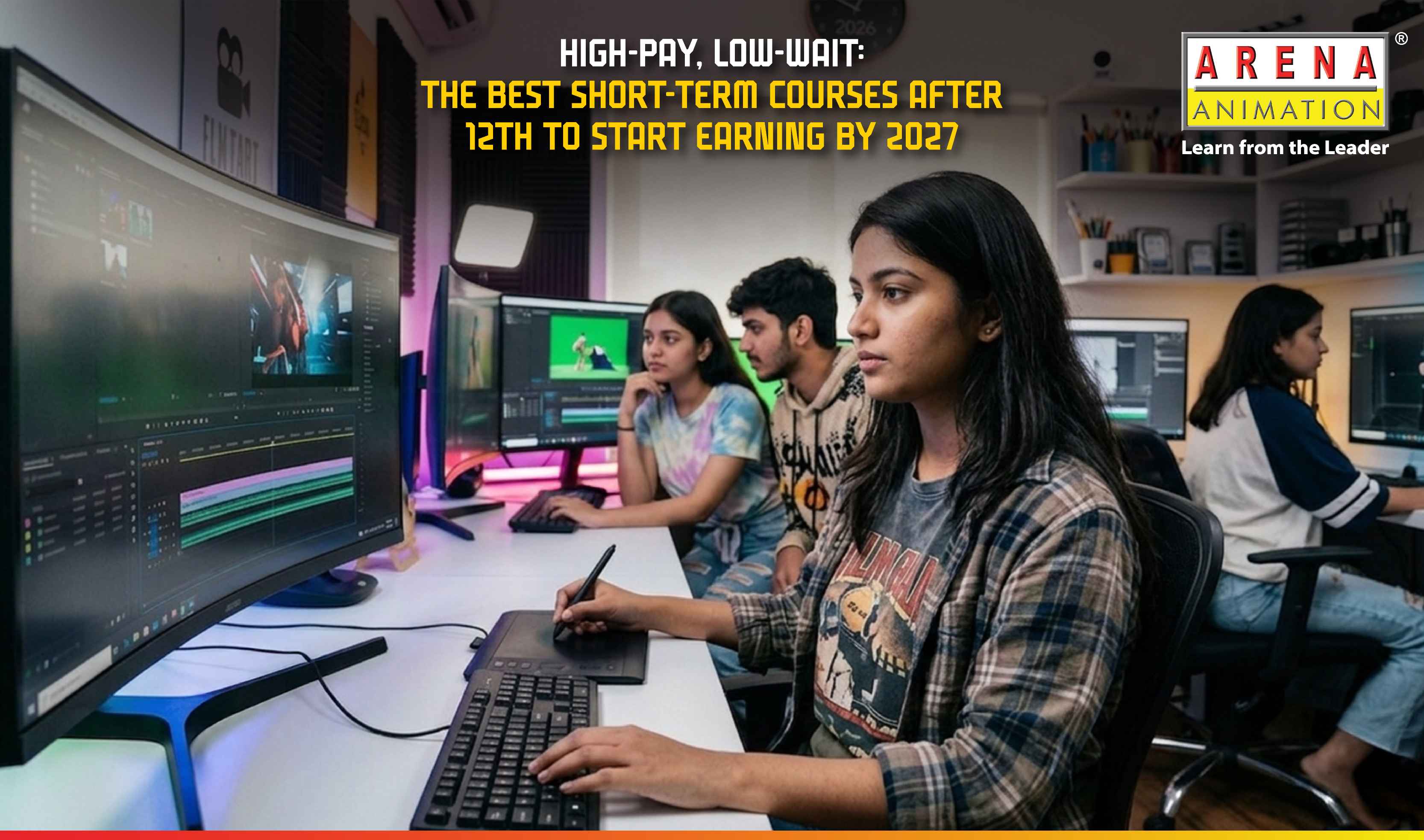
High-Pay, Low-Wait: The Best Short-Term Courses After 12th to Start Earning by 2027
Finishing your 12th boards often brings a very specific kind of stress. Everyone around you seems to have an opinion about what you should do next, and most of those opinions involve a three or four year degree that may or may not lead anywhere useful. If you have been quietly wondering whether there is a smarter, faster path, you are not wrong to question it.
The honest truth is that the job market in 2026 does not reward time spent as much as it rewards skill built. And for students who are serious about starting to earn before the decade is out, short-term courses after 12th in the right creative and tech fields can get you there faster than most traditional routes. Not as a shortcut, but as a genuinely better fit for the way hiring actually works in industries like digital marketing, graphic design, content creation, web development and UI/UX today.
Why the Rules Have Changed for Students
A few years ago, skipping a degree felt risky. Employers used qualifications as a filter, almost by default. That filter is still there in certain fields, but in creative and digital careers, there’s now a much stronger focus on skills, portfolios and real-world work.
What most studios, agencies and product companies want to see today is work. A reel, a portfolio, a set of projects that show you understand the craft and can deliver something real. A student who finishes a focused, well-structured program with a solid portfolio is often more hireable than someone who spent three years in a general course and has little to show for it.
This shift is not just a trend or a headline. It is visible in how job postings are written, in how creative recruiters talk about what they look for and in the career paths of working professionals who built their skills through focused training rather than conventional degrees.
For students who finished their twelfth and are ready to move with intention, the question is not whether short-term training programs work. The question is which ones are worth your time.
Motion and Graphic Design: Still One of the Strongest Bets
If you have any instinct toward visual work, motion and graphic design is one of the most well-rounded directions you can move into right now. The demand for it has not softened. If anything, the explosion of digital content across every platform imaginable has made it more constant than ever.
Think about how much visual content people consume every day. Every reel, brand post, explainer video and app interface involves design decisions behind the scenes. Someone built those transitions, chose those fonts, set that colour palette and decided how the eye should move through the frame. That someone is a motion or graphic designer, and businesses of all sizes need them continuously.
What makes this field particularly good for a student coming out of their twelfth is that it rewards taste and practice more than age or academic background. You are not competing on years of experience. You are competing on what you have made and that is a playing field you can enter quickly if you train properly.
Programs such as Arena Animation’s Next Gen Visual Design and Motion Graphics course are designed around these industry requirements. You learn the fundamentals of graphic design alongside motion, animation and visual effects, using industry tools that employers actually recognise. By the time you finish you have real projects behind you, not just certificates.
VFX: High Demand, Surprisingly Accessible Entry Point
Visual effects used to feel like something reserved for big Bollywood productions or Hollywood studios. That is no longer the reality. VFX work today shows up in advertising, social media content, YouTube channels, corporate videos, streaming platforms and gaming. The market for it has widened considerably, which means the number of entry points has widened too.
A short term VFX course that is structured well can take a student from zero to job-ready in a relatively compact timeframe, provided the training is hands-on and built around real briefs rather than theory alone.
Arena Animation's Advanced Program in VFX Compositing and Editing covers the core of what employers actually look for. Compositing, colour grading, rotoscoping, motion graphics, sound design, editing for film and media, all of it using tools like Nuke and industry-standard software that professionals use daily. The program is designed to build a demo reel, which in the VFX world is the single most important thing you can walk into an interview with.
For students who are drawn to the visual side of storytelling and want a career that sits at the intersection of technology and creativity, VFX is one of the more compelling paths available right now.
Generative AI: The Newest Short-Term Opportunity
If you have spent any time over the past year watching how quickly AI tools have changed what is possible in creative work, you have probably sensed that something significant is happening. That instinct is correct.
Generative AI is no longer a conversation about the future. It is already embedded in design workflows, content production, marketing, video creation and visual development. The professionals who understand how to use these tools well are genuinely in demand, and the number of people who have been properly trained in them is still relatively small.
This is exactly the kind of gap that a focused short term gen AI course can help you step into. Arena Animation's Master in Gen AI program covers the practical application of generative AI tools across content creation, visual design, video production and creative writing. It is not a theoretical introduction to what AI is. It is a hands-on program built around what these tools actually do in professional workflows and how to use them with intention.
For a student finishing their twelfth in 2025 or 2026, this is one of the most forward-looking directions available. The field is new enough that many professionals are still learning these tools alongside their existing workflows.
What Makes a Short-Term Program Actually Worth It
Not every program with a short duration is genuinely short-term training in the useful sense. Some are abbreviated versions of longer courses, rushed through in a way that leaves students with surface-level knowledge and nothing concrete to show for it.
The things that separate a good program from a mediocre one are fairly consistent. First, the quality of the projects you produce while learning. Second, whether the tools you are trained on are ones that employers actually use. Third, whether the program pushes you to build a portfolio rather than just sit through lessons. And fourth, whether there is any genuine support around placement and career readiness once you finish.
Arena Animation's short-term programs are built with an employment-driven approach which means the curriculum is shaped around what the industry needs rather than what is easiest to teach. Students work on real briefs, build reels and portfolios, go through interview preparation and get exposure to actual studio environments. That combination makes the transition from completing a course to beginning a career significantly shorter.
The Careers You Are Building Toward
Students who come through strong short-term programs in these areas move into a wide range of roles. Motion graphics artists work across advertising agencies, production houses and social media teams. VFX artists find work in film, streaming platforms, gaming and corporate media. Graphic designers are hired by brands, startups, digital agencies and as independent freelancers. Gen AI specialists are being absorbed into marketing teams, content studios and product companies that are still figuring out how to integrate these tools properly.
Freelancing is also a very real and immediate option. Many students who finish a focused program and have a portfolio behind them start picking up freelance work before they have even completed their course. Small businesses, content creators and growing brands need skilled creative professionals constantly and they hire based on what you can do, not what degree you hold.
The variety of entry points is actually one of the better arguments for these creative fields right now. You are not funnelling yourself into one narrow role. You are building a foundation that can take you in several directions depending on where your interest develops.
Final Thoughts
There is a version of the post-twelfth decision that involves waiting. Waiting to figure out what you want, waiting to see how things settle, waiting for a clearer picture of where the job market is going. That hesitation is understandable, but in fields that are moving this quickly, the students who start building real skills now are going to be measurably ahead of those who start two years later.
The creative and digital industries are not slowing down. The demand for motion and graphic design, VFX, generative AI skills and visual content of all kinds is going to be higher in 2027 than it is today. Getting your training in now, building a portfolio now and entering the market as early as possible gives you a compounding advantage that simply cannot be replicated by starting later.
Short-term training programs done well are not a consolation prize for students who did not take a traditional degree. For students willing to focus on building real skills, these creative fields offer one of the most direct paths from learning to earning.
STUDENT ENQUIRY
Join Arena Animation and turn your creative passion into a thriving career. Your story could be the next success we celebrate.

Did you find the information you were looking for?

At Arena Animation, we craft innovative digital solutions, empowering creativity and driving growth through cutting-edge animation and design expertise.