
The Rise of Short-Form Video: Skills Every Future Creator Needs...
From Prompt to Production: How AI Is Changing the Creative Workflow...
Perspectives 2026: Exploring the Future of Creative Careers in Animation, VFX, Gaming & Digital Desi...
The Edupreneur’s Advantage: How Opening An Arena Animation Franchise Delivers High-Yield Business Gr...
Real-Time Worlds: How An Unreal Engine Course Unlocks Careers In Gaming, Film Sets, And Virtual Real...
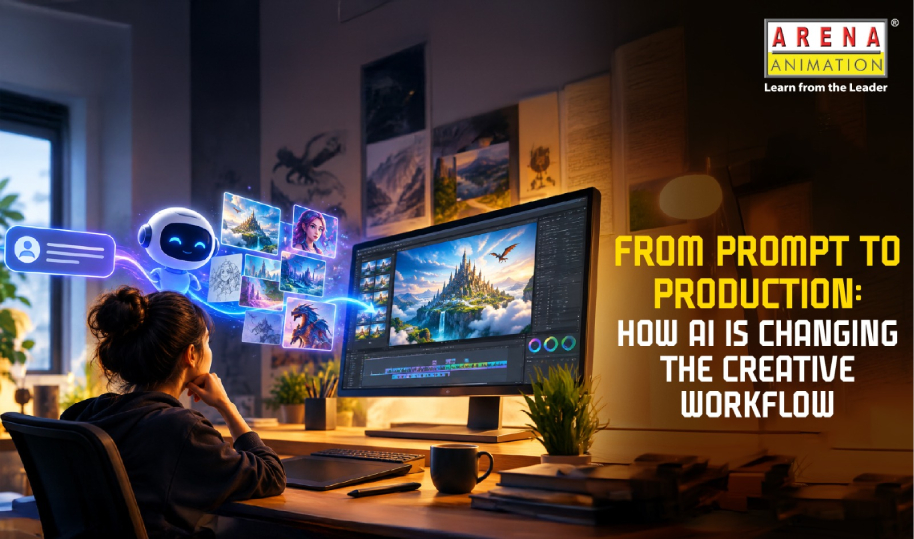
From Prompt to Production: How AI Is Changing the Creative Workflow
Creative production has always involved a sequence of decisions. An idea needs to be developed into a concept, visual references need to be explored, scenes need to be planned and the final content needs to be produced and refined. Generative AI is now becoming part of several stages of this process, changing how quickly creators can explore ideas and move from an initial thought towards production.
The important question is not whether AI will replace creative professionals, rather, how professionals can use AI while retaining creative judgement, storytelling ability and control over the final output.
This is where modern creative education needs to evolve. Arena Animation has introduced Gen AI into its learning ecosystem through dedicated offerings such as its Master in Gen AI and through AI-enabled components within digital content creation, animation and design programs. Its Master in Gen AI covers prompt engineering, creative writing, visual storytelling, video creation, audio, 3D model creation and responsible AI usage.
TL;DR
Generative AI is transforming creative production, from ideation and visual development to animation, 3D creation and post-production. While AI can make workflows faster, creative judgement and technical fundamentals remain essential. Learning to combine AI with design, animation and storytelling skills can help aspiring creators adapt to the evolving creative industry.
Table of Contents
- Why AI is changing creative production
- Ideation and concept development
- From storyboards to animation
- AI in editing and post-production
- How Arena is adapting creative education
- Why creators still need fundamentals
- Conclusion
- FAQs
Why AI Is Changing Creative Production
Traditional creative workflows can involve considerable time spent exploring alternatives before production begins. AI tools can accelerate some of these exploratory stages by helping creators generate references, develop variations and test different directions.
This does not remove the need for creative judgement. Instead, it changes where that judgement is applied.
From Execution to Direction
A creator may now generate several visual possibilities before deciding which one best communicates the intended mood. A designer can explore different compositions and then refine the strongest direction manually.
The advantage comes from reducing repetitive exploration while giving the creator more room to focus on concept, storytelling and refinement.
For students, this creates a new skill requirement. Learning a generative ai course is not simply about understanding prompts. It is about learning how AI can support a wider production workflow.
Ideation and Concept Development
The first stage of most creative projects is an idea. A concept needs to be explored before it becomes a finished visual.
Generative AI can assist with brainstorming, reference generation and early visual exploration. Arena's Master in Gen AI specifically includes creative writing and idea generation using Gen AI as well as visual storytelling.
Developing Better Prompts
Prompting is becoming a creative skill because the quality of an AI-generated result often depends on how clearly the creator communicates the intended outcome.
A vague prompt may produce a visually interesting image that has little relevance to the project. A more considered prompt can define subject, composition, mood, environment and style more effectively.
However, good prompting still begins with good creative thinking. Students need to understand visual language before they can consistently direct an AI system towards a useful result.
From Storyboards to Animation
Once an idea has been selected, it needs structure. Storyboarding translates an abstract concept into a sequence of scenes and helps determine how a story will unfold.
AI can assist with visual references and early scene exploration but storytelling decisions remain central. The creator still needs to determine pacing, framing, character action and emotional progression.
Connecting AI With 3D Production
The relationship between AI and 3D workflows is also becoming more relevant. Arena Animation's AI-enabled programs and courses incorporate emerging AI technologies alongside 3D design, animation, VFX and broader creative workflows.
This reflects a larger industry shift. Creative professionals increasingly need to understand how different technologies work together rather than treating each tool as an isolated skill.
A student taking a 3d animation and vfx course can therefore benefit from understanding where AI fits into modelling, concept development, asset creation and other stages of production.
AI in Editing and Post-Production
The workflow does not end when animation or footage has been created. Editing, sound, compositing, colour and other post-production processes determine how the final piece feels.
AI-assisted tools can help with tasks such as content generation, editing support and creative experimentation. This can reduce time spent on repetitive work and allow creators to concentrate on decisions that require context and judgement.
The Human Role in Final Decisions
An AI system can suggest an edit or generate an asset but it does not automatically understand the full intention behind a project.
An editor still needs to decide whether a transition fits the narrative. A designer needs to judge whether an AI-generated visual fits a brand. An animator needs to determine whether movement communicates the intended emotion.
The technology can accelerate production, but creative responsibility remains with the professional.
How Arena Is Adapting Creative Education
Arena Animation's current course portfolio demonstrates an increasing emphasis on AI-enabled learning. Its Digital Content Creation program includes an introduction to Generative AI covering text, image, music and code generation, alongside design, advertising and digital content skills.
The program also covers tools such as Photoshop, Illustrator, Premiere, Audition and After Effects, showing how AI can be introduced within a wider digital production environment rather than taught as a completely separate subject.
Arena also offers a Master in Gen AI as a short-term option. The program has a 38 hour duration and includes prompt engineering, visual storytelling, marketing innovation, dynamic design, video content creation, audio innovation and 3D model creation.
Why Creators Still Need Fundamentals
AI can make certain tasks faster but it does not eliminate the importance of foundational creative skills.
A designer needs composition and typography. An animator needs timing, movement and storytelling. An editor needs rhythm and narrative understanding. A VFX artist needs knowledge of perspective, lighting, compositing and visual continuity.
Technology Works Best With Creative Understanding
This is why a digital design course or animation program that combines technology with fundamentals can be more useful than learning isolated AI tools.
Students should understand why something works before using AI to produce it faster. Otherwise, they may generate technically polished content without developing the ability to judge quality.
The strongest creative professionals will therefore be those who can move comfortably between human ideation and AI-assisted execution.
Conclusion
Generative AI is changing creative production from the first prompt to the final frame. It can support ideation, concept development, storyboarding, visual exploration, 3D creation, editing and post-production but its value depends on how intelligently creators use it.
Arena Animation's growing focus on Gen AI within its short-term and broader creative programs reflects this changing workflow. For students, the opportunity is not simply to learn another technology. It is to understand how AI can become part of a complete creative process.
The future creator will not necessarily be the person who generates the most content, rather, the person who knows what to create, why it should be created and how technology can help turn that idea into effective visual communication.
FAQs
- Can AI be used in animation?
Ans - Yes. AI can support areas such as ideation, visual development, asset creation and parts of the wider production workflow.
- What does a digital content creation program teach?
Ans - It can cover areas such as visual communication, design, motion graphics, digital media and AI-assisted content creation depending on the program.
- Who should consider a short term Gen AI course?
Ans - Students, designers, content creators and professionals who want to understand practical applications of generative AI can consider a focused short-term program.
- Which Arena Animation courses include Gen AI tools?
Ans - Arena Animation includes Gen AI tools in several programs, including Digital Content Creation, Next Gen Graphic & Visual Design, Advanced Program in Animation and VFX, and Advanced Program in Animation with Unreal Engine. These programs combine AI exposure with broader creative and technical skills.
- Does Arena Animation offer a dedicated Gen AI course?
Ans - Yes. Arena Animation offers a dedicated Master in Gen AI as a short-term course. Its current course overview lists it alongside other short-term programs such as Master in Blender and Master in Unreal Engine.
- How is AI integrated into Arena Animation's creative programs?
Ans - AI is integrated into different stages of creative learning depending on the program. For example, Digital Content Creation includes Gen AI-powered social media content creation, while animation and VFX programs include AI Art Innovator and Gen AI tools alongside design, 3D, animation and VFX training.
STUDENT ENQUIRY
Join Arena Animation and turn your creative passion into a thriving career. Your story could be the next success we celebrate.

Did you find the information you were looking for?

At Arena Animation, we craft innovative digital solutions, empowering creativity and driving growth through cutting-edge animation and design expertise.