
The New Creative Career: Why Designers, Animators & Editors Are Becoming Multi-Skilled Creators...
The Rise of Short-Form Video: Skills Every Future Creator Needs...
From Prompt to Production: How AI Is Changing the Creative Workflow...
Perspectives 2026: Exploring the Future of Creative Careers in Animation, VFX, Gaming & Digital Desi...
The Edupreneur’s Advantage: How Opening An Arena Animation Franchise Delivers High-Yield Business Gr...
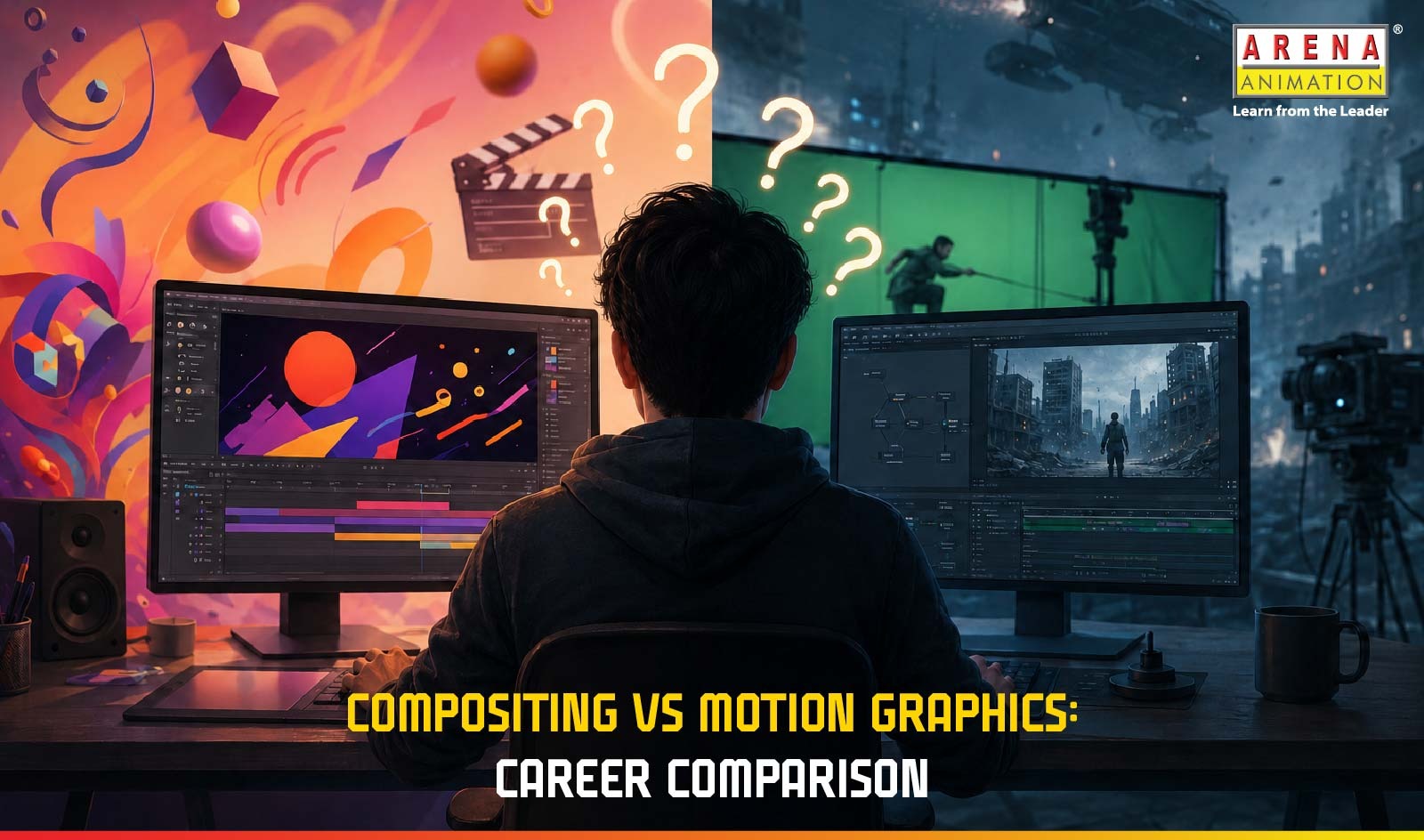
Compositing vs Motion Graphics: Career Comparison
A lot of students get stuck between compositing and motion graphics because from the outside, both fields seem to belong to the same world. You come across different animation, VFX and editing software, complex timelines and multiple tools, which can feel overwhelming for beginners after a point.
But once you spend some time understanding the actual work, the difference becomes much easier to understand.
Motion graphics are usually more expressive. It focuses on movement, design and visuals that are meant to immediately catch attention. Compositing feels quieter in comparison. The work is often about blending things so naturally into a scene that people never stop to think about how it was created.
Most students do not figure out which one suits them instantly. Usually, it becomes clearer slowly while learning.
Why Motion Graphics Career Feels So Dynamic
A motion graphics career is often chosen by students who enjoy visuals that feel energetic and constantly changing.
This is the kind of work you see everywhere now without always noticing it directly. From advertisements, Instagram reels, title sequences to app promos, YouTube intros and branded content, motion graphics have quietly become part of almost every form of digital media.
What makes the field interesting is that projects rarely feel exactly the same. One project may revolve around typography and branding while another may focus more on transitions and animated storytelling.
For people who enjoy experimenting creatively, that variety keeps the work engaging.
At the same time, motion graphics also require patience. Something that looks smooth and effortless for a few seconds on screen may have taken hours of tiny adjustments behind the scenes.
What The Learning Process Actually Feels Like
A motion graphics course usually starts more slowly than students expect.
Most beginners assume they will immediately start creating flashy animations but the early learning process is much more focused on the basics. Timing, spacing, typography and pacing are the small things that do not seem exciting initially but slowly start making sense later.
In the beginning, even simple animations can feel frustrating. You move one layer slightly and suddenly the entire sequence feels awkward or you fix one transition and another part stops working properly.
At Arena Animation, students are introduced to motion design alongside visual storytelling and communication concepts which helps them understand not only how animation works but also why certain visuals feel satisfying to watch.
The Software Most Students Eventually Struggle With
For most students entering motion graphics, joining an after effects course becomes part of the process sooner or later.
Adobe After Effects is one of the most widely used tools across motion graphics, digital media and creative video production. It is powerful, flexible and slightly intimidating in the beginning.
Almost everyone feels overwhelmed when opening the software for the first time. Too many panels, too many effects, timelines that suddenly become messy within minutes.
Most beginners spend a surprising amount of time trying to figure out why their animation stopped working or where a layer disappeared.
But after a while, the software starts feeling less mechanical and more familiar. You begin noticing movement differently, even while casually watching advertisements or social media videos. That shift happens quietly over time.
The Side Of Visual Effects That Stays Invisible
VFX compositing feels very different once you actually begin working on it.
Unlike motion graphics, which is often designed to stand out visually, compositing usually tries to remain invisible. The goal is to combine multiple visual elements so naturally that the audience never questions what is real and what was added later.
Compositors work with green screen footage, CGI elements, tracking, lighting corrections and scene integration. Sometimes a single shot contains several layers that all need to feel like they belong together perfectly.
The work requires a different kind of patience because small inconsistencies can quietly ruin the realism of a scene.
And honestly, people usually only notice compositing when it has been done badly. Good compositing disappears into the scene without drawing attention to itself.
Understanding Professional Compositing Workflows
Students interested in compositing usually come across a nuke silhouette course during their learning journey.
Nuke is commonly used in film and large scale VFX production for compositing heavy projects, while Silhouette is widely used for rotoscoping and cleanup work.
Compared to motion graphics, the workflow here feels more technical and detail oriented. There is more focus on masks, tracking, scene correction and layer integration.
At Arena Animation, compositing based programs gradually introduce students to these workflows so the software feels less overwhelming over time.
Because honestly, compositing software can look extremely confusing in the beginning when every project suddenly seems filled with endless nodes and layers.
Why Creative Roles Are Blending Together
One thing students slowly notice is that visual design and motion arts overlap much more now than they used to.
Motion designers sometimes work on compositing heavy projects. Compositors may contribute to stylised sequences involving animated graphics and visual design elements.
The industry itself has become more flexible. Creative professionals often move across related areas depending on the projects they work on.
That is why many students eventually end up learning skills across both fields instead of limiting themselves to one forever.
Final Thoughts
Choosing between compositing and motion graphics can feel confusing initially because both careers exist so close to each other within digital media and entertainment.
But after some practical exposure, the difference usually becomes more natural to understand. Motion graphics is often driven by movement, communication and visual style while compositing focuses more on realism and seamless integration.
Both fields continue growing across advertising, films, OTT content and online media. In the end, the better path is usually the one whose process still feels interesting even after the excitement of starting something new begins settling down.
FAQs
1. What is the difference between motion graphics and vfx compositing?
Motion graphics focus on animated visuals and communication while vfx compositing combines multiple visual elements into realistic scenes.
2. Is a motion graphics career a good option?
Yes. A motion graphics career offers opportunities in advertising, branding, social media and digital content production.
3. What is taught in a motion graphics course?
A motion graphics course usually includes typography, animation principles, transitions and visual storytelling.
4. Why is an after effects course important?
An after effects course helps students learn one of the most widely used tools for motion graphics and digital content creation.
5. What is included in a nuke silhouette course?
A nuke silhouette course generally covers compositing, tracking, rotoscoping and VFX production workflows.
STUDENT ENQUIRY
Join Arena Animation and turn your creative passion into a thriving career. Your story could be the next success we celebrate.

Did you find the information you were looking for?

At Arena Animation, we craft innovative digital solutions, empowering creativity and driving growth through cutting-edge animation and design expertise.