
The New Creative Career: Why Designers, Animators & Editors Are Becoming Multi-Skilled Creators...
The Rise of Short-Form Video: Skills Every Future Creator Needs...
From Prompt to Production: How AI Is Changing the Creative Workflow...
Perspectives 2026: Exploring the Future of Creative Careers in Animation, VFX, Gaming & Digital Desi...
The Edupreneur’s Advantage: How Opening An Arena Animation Franchise Delivers High-Yield Business Gr...
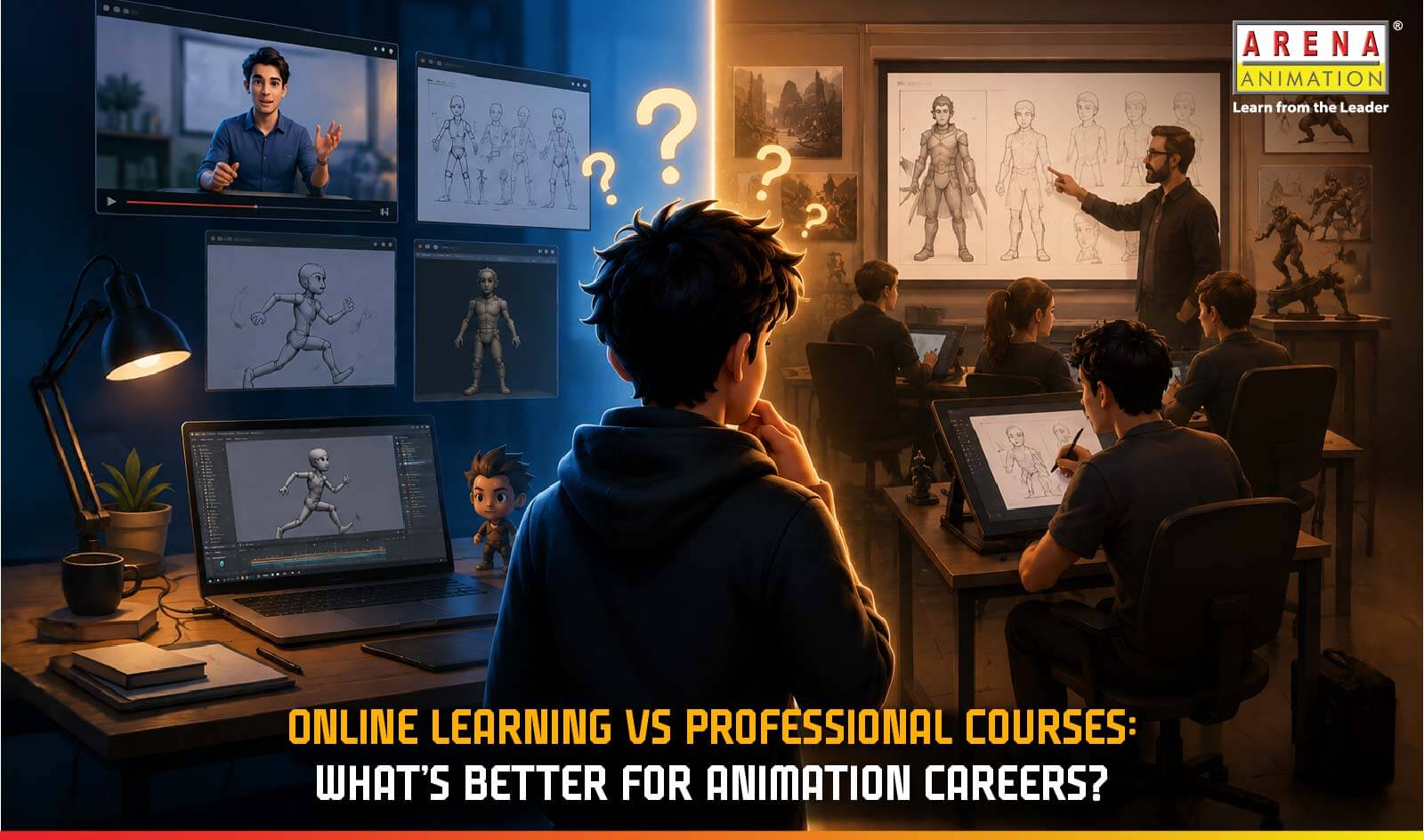
Online Learning vs Professional Courses: What’s Better for Animation Careers?
A few years ago, learning animation usually meant attending physical classes, sitting in computer labs for hours and practising under a trainer’s supervision. Now things look very different. Someone can literally sit at home with a laptop, open YouTube or an online platform and start learning animation the same day.
Because of this shift, a lot of students get stuck on one question very early. Should they learn through online animation courses or join a professional animation training institute instead?
Honestly, there is no one line answer to this because both options have advantages. But the better choice usually depends on what someone actually wants from their career, how disciplined they are and whether they need industry exposure beyond software tutorials.
Why So Many Students Prefer to Learn Animation Online
There is a reason online learning has become so popular, especially after the last few years. It feels flexible, accessible and less intimidating for beginners.
A student can learn animation online from anywhere, pause lessons whenever needed and revisit difficult topics multiple times. For people balancing college, freelance work or part time jobs, that flexibility becomes very useful.
Online animation courses are also often cheaper compared to long term professional programs. Someone curious about animation can start experimenting without making a huge financial commitment immediately.
Another thing students like is the freedom to learn at their own pace. Some people grasp software quickly while others need more time. Online platforms allow both types of learners to move comfortably.
For beginners who simply want to explore whether animation interests them or not, online learning honestly works quite well.
The Problem With Only Learning Online
At the same time, online learning has a downside people do not talk about enough. Most students start enthusiastically and then slowly lose consistency after a few weeks.
Animation is one of those fields where tutorials alone are usually not enough. Watching someone animate a character is very different from building timing, movement and storytelling skills yourself.
A lot of students also end up learning software shortcuts without understanding actual animation principles. Eventually, their work starts looking technically correct but creatively weak.
This is where professional training often changes things.
At a good animation training institute, students usually work on projects with deadlines, mentor feedback and portfolio reviews. That structure pushes people to improve consistently instead of learning randomly whenever motivation appears.
Institutes like Arena Animation focus heavily on practical learning because the animation industry expects much more than software knowledge now. Students are often trained through assignments, short films, motion graphics projects and collaborative work environments that resemble studio culture.
Why Professional Courses Feel More Industry Focused
One major difference between online learning and professional courses is exposure.
When students join structured programs, they are not only learning tools like Maya, Blender or After Effects. They are also understanding pipelines, teamwork, deadlines and presentation skills. Those things matter a lot during actual production work.
For example, many graphic design and animation programs at Arena Animation include portfolio building, VFX fundamentals and motion graphics alongside animation training itself. Some courses even introduce students to production style workflows where projects move through multiple stages just like real studios.
That environment is difficult to recreate through isolated online tutorials.
Professional institutes also tend to update course structures according to industry demand. Right now, studios expect artists who understand multiple areas instead of only one narrow skill. Someone learning animation today may also need basic compositing, editing or motion graphics knowledge.
This is one reason many students eventually move from online animation courses to full professional programs later.
The Importance of Placement Support
This is probably the biggest factor students underestimate while comparing online vs offline courses.
Learning animation is one thing. Entering the industry is another thing entirely.
A lot of online platforms teach software but leave students completely on their own after course completion. There is rarely any proper placement support, portfolio guidance or interview preparation.
Professional institutes usually help much more in this area.
At institutes like Arena Animation students often receive portfolio reviews, studio interview preparation and career guidance. Some programs are even designed as a course with job placement assistance because many students join specifically to build employable industry skills.
That support becomes extremely important for beginners who have talent but no industry connections yet.
What is the Best Way to Learn Animation?
The best way to learn animation is usually a combination of both, online learning and professional courses.
Online learning is excellent for exploration, extra practice and improving specific technical skills. It gives flexibility and access to global tutorials that can genuinely help students grow.
But professional training often provides structure, mentorship, feedback and industry exposure that many self learners struggle to build alone.
Students who succeed in animation careers usually do something interesting. They attend structured classes, work on projects seriously and still continue learning online in their free time. The industry changes constantly anyway, so continuous learning never really stops.
Why the Learning Environment Matters More Than People Think
Animation can sometimes feel frustrating because progress happens slowly. A student may spend hours fixing tiny movements that nobody else even notices. During those phases, having mentors and peers around actually helps a lot.
That is one reason classroom environments still matter despite the growth of online learning. Being surrounded by people working on similar creative goals naturally pushes motivation higher.
At Arena Animation, students often work on collaborative assignments and portfolio projects together, which creates a much more studio-like atmosphere compared to learning completely alone.
In the end, software can always be learned online. But creative growth usually happens faster when guidance, structure and practical exposure come together.
FAQs
1. Are online animation courses enough for getting a job?
They can help build technical skills, but many students still struggle with portfolio development and industry exposure without professional guidance.
2. What is better in online vs offline courses for animation?
Online learning offers flexibility while offline professional training usually provides mentorship, project experience and placement support.
3. Can I learn animation online for free?
Yes, many free resources are available online. However, structured learning often helps students progress faster and more consistently.
4. Why join an animation training institute?
An animation training institute usually offers guided learning, portfolio development, mentor feedback and career support that independent learning may lack.
5. Do institutes provide courses with job placement opportunities?
Institutes like Arena Animation provide placement support, interview preparation and career assistance for students completing industry focused programs.
STUDENT ENQUIRY
Join Arena Animation and turn your creative passion into a thriving career. Your story could be the next success we celebrate.

Did you find the information you were looking for?

At Arena Animation, we craft innovative digital solutions, empowering creativity and driving growth through cutting-edge animation and design expertise.