
The New Creative Career: Why Designers, Animators & Editors Are Becoming Multi-Skilled Creators...
How to Start a Career in Animation After 12th: Courses, Skills and Scope...
Animation vs VFX: Key Differences, Career Scope and Which Course to Choose...
The Rise of Short-Form Video: Skills Every Future Creator Needs...
From Prompt to Production: How AI Is Changing the Creative Workflow...
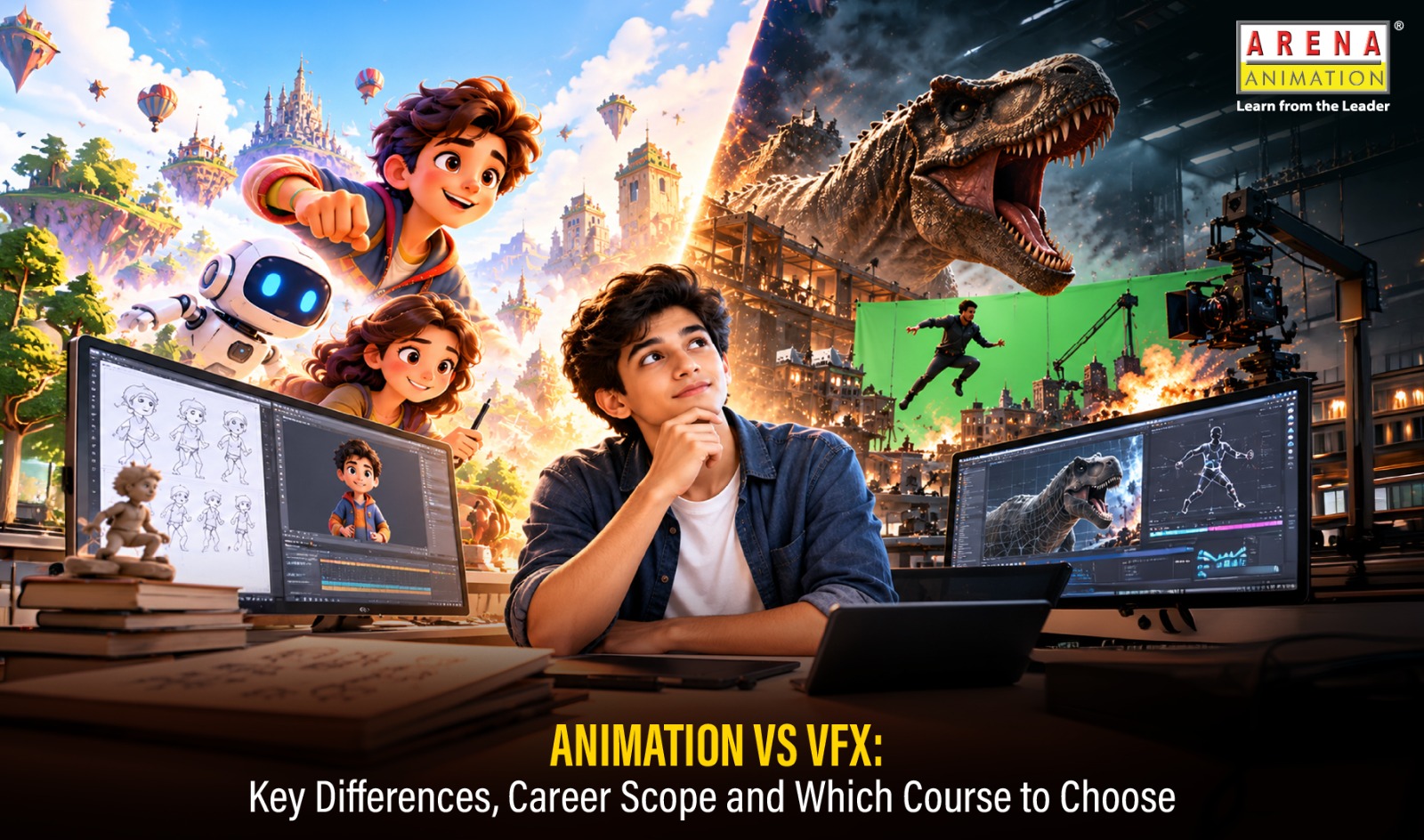
Animation vs VFX: Key Differences, Career Scope and Which Course to Choose
Animation and VFX are often discussed together but they are not the same discipline. Animation focuses on creating movement, characters, environments and stories from designed or digitally created elements. VFX combines digital effects with live-action or computer-generated footage to create visuals that may be difficult to capture naturally.
Understanding the difference between animation and VFX can help students choose a learning path that matches their interests. Both fields offer opportunities across films, OTT, advertising, gaming and digital content but their workflows can differ.
Table of Contents
- The difference between animation and VFX
- Where animation and VFX overlap
- Career scope in animation
- Career scope in VFX
- Choosing between animation and VFX
- Building skills for the creative industry
- Conclusion
- FAQs
The Difference Between Animation and VFX
Animation involves creating movement and visual storytelling. Artists may design characters, model 3D assets, create environments, rig characters and produce animated sequences.
VFX usually begins with footage, digital elements or both. Artists may use compositing, rotoscoping, camera tracking, simulations and other techniques to integrate visual elements into a finished shot.
In simple terms, animation creates the visual world and its movement, while VFX often modifies, enhances or combines visual elements to create the final image.
Where Animation and VFX Overlap
The difference between animation and VFX becomes less distinct in modern production pipelines. Both can involve 3D modelling, lighting, motion, compositing and digital storytelling.
Arena Animation’s Advanced Program in Animation and VFX reflects this overlap. The programme covers 3D modelling, texturing, rigging, animation, FX and compositing, along with cinematography, colour, lighting, motion graphics and digital sound. It also includes tools such as Autodesk Maya, Houdini, Nuke, Silhouette and 3D Equalizer.
Career Scope in Animation
Animation can lead to roles across entertainment, advertising, gaming and digital media. Professionals can work as 3D animators, character riggers, 3D modelers, environment artists, lighting artists, storyboard artists or motion graphics designers.
Students interested in real-time production can explore Arena Animation’s Advanced Program in Animation with Unreal Engine. It focuses on real-time animation, cinematic storytelling, motion capture, simulations, lighting, camera work and environment design.
Career Scope in VFX
VFX offers career paths in compositing, rotoscoping, matchmoving, FX, lighting and post-production. A visual effects course can suit students who enjoy combining technical processes with cinematic storytelling.
Arena Animation’s Advanced Program in Visual Effects covers cinematography, colour and lighting, storyboarding, editing, sound, motion graphics, advanced roto, compositing and AI-supported workflows. Career options in VFX include VFX artist, compositor, FX artist, lighting and rendering artist, technical artist, roto artist and VFX supervisor.
Choosing Between Animation and VFX
The right choice depends on what students enjoy creating. Those interested in characters, movement, world-building and digital storytelling may prefer animation. Students who enjoy transforming footage, creating cinematic effects and combining live action with digital elements may find VFX more suitable.
However, students do not always have to choose one area in isolation. A 3D animation and VFX course can introduce learners to connected stages of production and show how specialists contribute to a finished visual.
Building Skills for the Creative Industry
Choosing a course is only one part of preparing for a creative career. Students also need practical projects that demonstrate how they apply their skills.
A strong portfolio could include a short animated sequence, a 3D character, a VFX shot or a composited scene. Complete projects help students understand how design, animation, editing and effects connect within a production pipeline.
For learners comparing the best VFX institute in India, it is useful to look beyond course titles. Factors such as curriculum, software exposure, practical training, portfolio development, industry interaction and career support can help students evaluate whether a programme matches their goals.
Conclusion
Animation and VFX are closely connected but involve different creative and technical processes. Animation focuses on creating movement and digital worlds, while VFX often integrates, enhances or transforms visual elements to create a finished shot.
An animation and VFX course can provide broader exposure for students who want to understand both areas. Those seeking deeper specialisation can consider a visual effects course or an animation-focused programme based on their interests.
A strong learning pathway builds fundamentals, practical experience and a portfolio while leaving room for specialisation.
FAQs
- What is the difference between animation and VFX?
Ans - Animation creates movement, characters and digital environments, while VFX focuses on creating or integrating visual effects into footage and digital scenes.
- Is an animation and VFX course suitable for beginners?
Ans - Yes. Arena Animation’s Advanced Program in Animation and VFX starts with creative design and digital media before progressing into 3D design, animation, FX and compositing.
- What does a 3D animation and VFX course teach?
Ans - It can cover 3D modelling, texturing, lighting, rigging, animation, effects and compositing, depending on the programme.
- What does a visual effects course cover?
Ans - A visual effects course can cover compositing, rotoscoping, camera tracking, motion graphics, colour, lighting and post-production.
- How should I choose the best VFX institute in India?
Ans - Compare the curriculum, practical training, software, portfolio opportunities, faculty, industry exposure and career support before choosing a programme.
- What careers can I pursue after an animation and VFX course?
Ans - Students can explore roles such as 3D animator, VFX artist, compositor, FX artist and motion graphics designer across films, gaming, advertising and digital media.
STUDENT ENQUIRY
Join Arena Animation and turn your creative passion into a thriving career. Your story could be the next success we celebrate.

Did you find the information you were looking for?
At Arena Animation, we craft innovative digital solutions, empowering creativity and driving growth through cutting-edge animation and design expertise.